
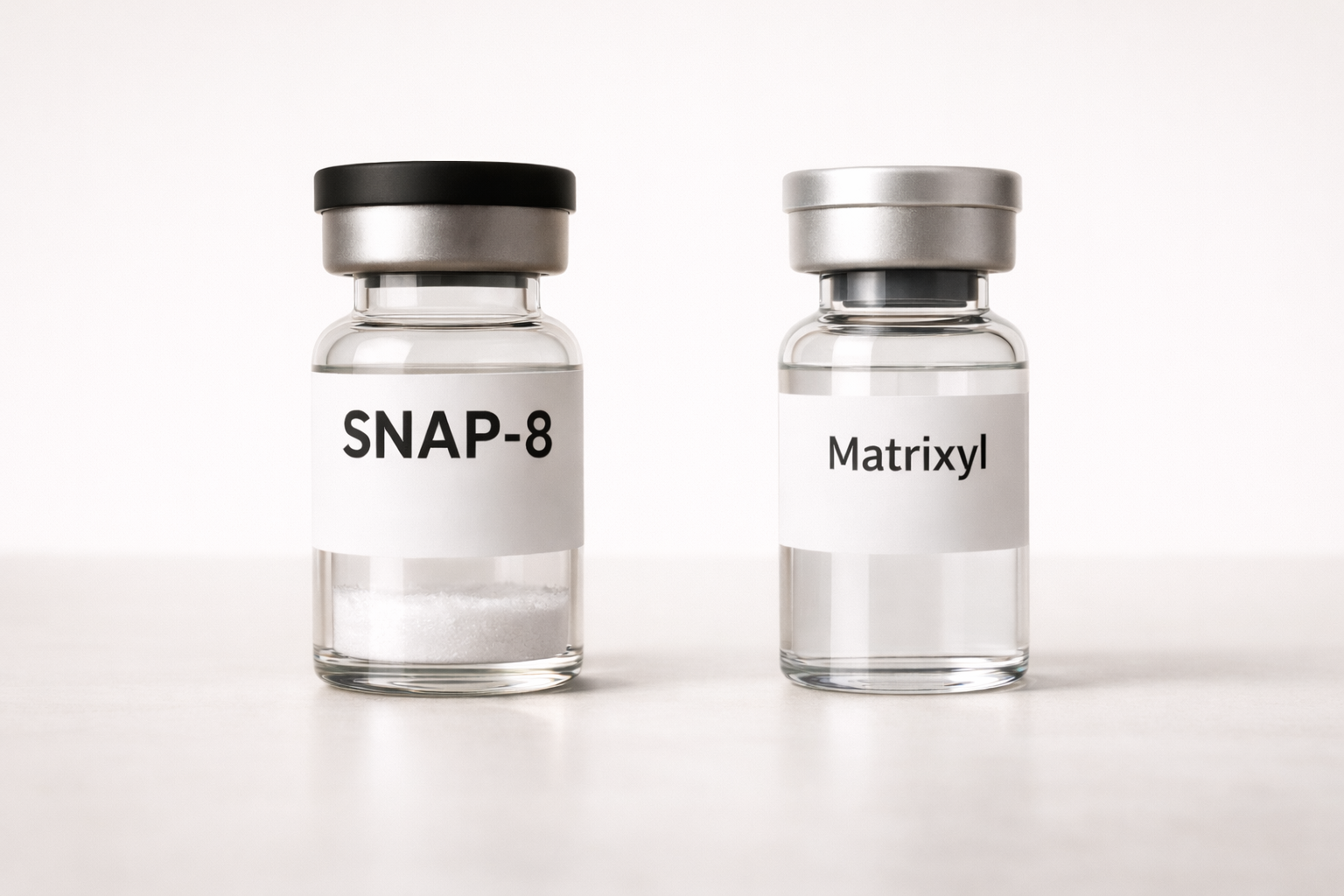
The year 2026 has cemented a new paradigm in the science of dermatological aging. We have moved beyond the era of generic “anti-aging” creams into a sophisticated landscape of precision peptides. In this modern hierarchy, two names dominate the conversation: SNAP-8 peptide (Acetyl Octapeptide-3) and Matrixyl (specifically Palmitoyl Pentapeptide-4 and its successors). While both are lauded for their ability to turn back the clock, they are biochemically distinct tools designed to address two entirely different causes of skin aging.
To choose the right ingredient, or to use them in tandem, one must understand the difference between a “neuromodulator” and a “matricin.” This article provides a comparison of SNAP-8 and Matrixyl. It details their molecular mechanisms, clinical results, and why the most advanced 2026 regimens no longer choose between them, but rather leverage their combined power for a 360-degree approach to facial rejuvenation.
For the full comparison hub (alternatives, myths, safety, and research highlights), see SNAP-8 vs alternatives.
Molecular Archetypes: The Architect vs. The Peacekeeper
The fundamental distinction between these two peptides lies in their target. One seeks to rebuild the “house” of the skin, while the other aims to stop the “earthquakes” that cause it to crack.
Matrixyl: The Architect of the Dermis
Matrixyl belongs to a class of peptides known as signal peptides or matricins. These molecules act as biological messengers that “trick” the skin into thinking its collagen has been damaged. In response, the skin triggers a repair cascade, activating fibroblasts to synthesize new structural proteins.
Matrixyl doesn’t just stimulate collagen. It also promotes the production of the entire extracellular matrix, including elastin, fibronectin, and glycosaminoglycans (GAGs). It is effectively a builder, focusing on the density and thickness of the skin itself [1, 8].
SNAP-8: The Peacekeeper of the Nerve
SNAP-8 belongs to the class of neurotransmitter-inhibiting peptides. Its mission is not to build new tissue, but to reduce the mechanical stress placed on existing tissue. By inhibiting the signals that cause facial muscles to contract, SNAP-8 keeps the skin surface calm.
If Matrixyl is the architect repairing the walls, SNAP-8 is the peacekeeper ensuring that repetitive facial expressions (the earthquakes) do not continue to fracture those walls. This makes SNAP-8 a functional “relaxer” rather than a structural “rebuilder” [2, 7].
Mechanism of Action: Dermal Repair vs. SNARE Inhibition
Understanding how these molecules work at a cellular level explains why they produce such different visual results.
The Matrixyl Signaling Cascade
Matrixyl (Palmitoyl Pentapeptide-4) is composed of five amino acids attached to a palmitic acid chain for better penetration [2]. Once it enters the dermis, it binds to specific receptors on the surface of fibroblast cells [3]. This binding sends a signal to the nucleus to “upregulate” the production of Type I and Type III collagen.
By 2026, newer versions like Matrixyl 3000 have added tetrapeptides that specifically target the reduction of interleukin-6. This is an inflammatory marker that leads to “inflammaging” and the degradation of the skin matrix. The result is a firmer, “plumper” skin appearance from the inside out [1, 8].
The SNAP-8 SNARE Destabilization
SNAP-8 works through a process called competitive inhibition. In the nerve terminals, a protein complex called the SNARE complex acts as a biological zipper that allows the release of acetylcholine. Acetylcholine is the chemical “go” signal for muscle contraction.
SNAP-8 mimics one of the proteins in that zipper (SNAP-25). By sliding into the complex where the real protein should be, it creates a “defective” zipper. The nerve can still attempt to send the signal, but it is weakened. This leads to a measurable reduction in the intensity of muscle contractions, particularly in areas prone to “expression lines” like the forehead and around the eyes [2, 4, 7].
Clinical Performance: What Data Says
The clinical trials of the past 24 months have provided high-resolution data on the efficacy of both ingredients. Ultimately, they help confirm their roles in the modern skincare routine.
Matrixyl Clinical Summary
In studies documented on Clinical Trials and published in MDPI, Matrixyl has shown a consistent ability to improve skin thickness. One 12-week trial involving women aged 35 to 55 demonstrated that a Matrixyl-rich formulation led to a significant reduction in “roughness” and a visible increase in skin density.
Wrinkle Volume: Reduction of up to 31%.
Skin Thickness: Increase of approximately 4% to 6%.
Hydration: Significant improvement due to the stimulation of glycosaminoglycans [1, 2]
SNAP-8 Clinical Summary
SNAP-8 results are often more localized and focused on “depth” rather than “density.” A 2024 study recorded that a 10% SNAP-8 solution, applied twice daily, reduced wrinkle depth around the eyes by an average of 35% to 38% within 28 days. In specific cases of deep horizontal forehead lines, the reduction in depth reached as high as 63% [4, 7].
The Evolution of Matricins: Matrixyl 3000 vs. Synthe 6
The “Matrixyl” brand has expanded into several specialized versions. Understanding which one you are using is vital for managing expectations.
Matrixyl 3000: The Maintenance Standard
Matrixyl 3000 is a combination of two peptides: Palmitoyl Tripeptide-1 and Palmitoyl Tetrapeptide-7. While the former mimics collagen fragments to trigger repair, the latter is specifically designed to suppress the production of interleukins. Interleukins are the chemicals that cause chronic inflammation. This makes Matrixyl 3000 an excellent daily defense against “inflammaging.” This is particularly true for those with sensitive skin who cannot tolerate harsher active ingredients [1, 8].
Matrixyl Synthe 6: The “Deep Filler”
Palmitoyl Tripeptide-38, known commercially as Matrixyl Synthe 6, is the more aggressive architect. It stimulates six major constituents of the skin matrix: Collagen I, III, IV, Fibronectin, Hyaluronic Acid, and Laminin-5. In clinical studies, it is particularly noted for its ability to “fill in” deep furrows on the forehead and crow’s feet by rebuilding the dermal-epidermal junction [3, 8]
SNAP-8: The Strategic Successor to Argireline
Many consumers in 2026 are familiar with Argireline (Acetyl Hexapeptide-8). However, SNAP-8 (Acetyl Octapeptide-3) is functionally a “version 2.0.”
The Power of the Octapeptide
The “8” in SNAP-8 refers to its sequence of eight amino acids, compared to the six found in Argireline. This longer chain allows for a more stable and high-affinity interaction with the SNARE complex. Research published in MDPI shows that SNAP-8 is approximately 30% more potent than its predecessor in reducing muscle contraction intensity [2, 7].
Why “Octa” Beats “Hexa”
The additional amino acids in the SNAP-8 chain allow the molecule to more effectively “clog” the neurotransmitter release machinery. While Argireline might dampen a contraction, SNAP-8 provides a more profound relaxation. This is why SNAP-8 has become the preferred choice for those looking for a “non-invasive edge” that actually rivals the smoothing effect of low-dose injectable toxins [4, 7].
The Dynamic vs. Static Conflict: A Case Study
It’s important to look at how skin actually ages. Wrinkles are not a monolith. They are the result of two competing forces.
- The Force of Expression: Every time you smile or squint, your muscles pull the skin into folds. Over time, these folds become permanent.
- The Force of Atrophy: As you age, your skin loses the collagen “spring” that allows it to bounce back from those folds.
SNAP-8 addresses the first force. By relaxing the muscle, it prevents the folding from occurring in the first place. Matrixyl addresses the second force. By thickening the skin, it makes the skin more resilient to the folding that does occur. Without SNAP-8, Matrixyl is constantly fighting a losing battle against repetitive muscle movement. Without Matrixyl, SNAP-8 might smooth the surface, but the skin will still look thin and translucent [1, 2, 7].
Targeted Delivery: Bypassing the Stratum Corneum
The biggest challenge for any peptide in 2026 remains penetration. Both SNAP-8 and Matrixyl are relatively large molecules that prefer water-based environments, while the skin barrier is oil-based.
Liposomal Encapsulation
Modern 2026 formulations rarely use “naked” peptides. Instead, they wrap them in microscopic fat bubbles that mimic the skin’s own cell membranes. This allows Matrixyl to reach the fibroblasts in the deep dermis and SNAP-8 to reach the nerve endings at the neuromuscular junction [1, 6].
For a study-backed breakdown of common misconceptions (including penetration claims), read Top 5 SNAP-8 myths debunked.
The Role of Iontophoresis and Microneedling
For those seeking “medical-grade” results at home, clinical data supports the use of delivery-enhancement tools. A study on Clinical Trials demonstrated that using a 0.25mm microneedle “stamp” before applying a SNAP-8/Matrixyl cocktail increased peptide absorption by over 400%, leading to results that were visible in half the usual time [4, 6].
The Cumulative Effect: Why Consistency is King
Unlike Botox, which offers a “binary” result (the muscle works or it doesn’t), peptides offer a linear result.
The Matrixyl “Bank Account”
Think of collagen as a savings account. Every day you use Matrixyl, you are making a small deposit. For the first 30 days, you may not see a change on the surface. However, by day 90, the cumulative increase in collagen density becomes a visible “plumpness.” If you stop using it, the deposits stop, and natural aging begins to withdraw from your account again [5, 8].
The SNAP-8 “Muscle Memory”
SNAP-8 requires daily application because the body naturally recycles the “fake” proteins it uses to block the SNARE complex. However, there is a secondary benefit: by keeping the muscle relaxed for months at a time, the muscle actually “forgets” how to contract at full intensity. This leads to a long-term softening of the face that persists even if a few days of application are missed [2, 4].
Histological Impact: What Happens Under the Microscope?
When we examine skin treated with the SNAP-8/Matrixyl combination under high magnification, the biological changes are profound.
Fibroblast Rejuvenation
Fibroblasts are the “factory” cells of the skin [9]. As we age, they become dormant or “senescent.” Matrixyl essentially acts as a wake-up call. Histological samples in 2025 research show that treated fibroblasts appear more elongated and active, similar to those found in much younger tissue. They are seen actively secreting pro-collagen fibers into the surrounding matrix [1, 3].
Anchoring Fibrils and the DEJ
One of the most critical areas of aging is the Dermal-Epidermal Junction (DEJ). This is the place where the top layer of skin meets the bottom layer [10]. Aging causes this junction to flatten, leading to sagging [11]. Matrixyl Synthe 6 specifically targets the “anchoring fibrils” (Collagen IV and Laminin) that hold this junction together. Under the microscope, a well-treated DEJ looks “wavy” and tightly bound, whereas aging skin shows a flat, weak connection [8, 11].
Long-Term Genetic Expression and Epigenetics
A groundbreaking area of study in 2025 involves how these peptides influence gene expression in the skin. This is a field known as nutricosmetics or epigenetic skincare.
Upregulation of Longevity Genes
Matrixyl has been shown to influence the expression of genes associated with skin longevity. By signaling the cells to behave as though they are in a state of repair, it keeps the “youthful” genetic pathways open. This prevents the “shut down” of collagen production that normally occurs after age 40 [5, 10].
SNAP-8 and Signal Fatigue
While SNAP-8 targets proteins, it also helps prevent “signal fatigue” in the nerves. Constant, high-intensity signaling from the brain to facial muscles can lead to oxidative stress within the nerve terminal. By buffering this signal, SNAP-8 may have a protective effect on the micro-nerves of the face. This ensures they remain healthy and responsive rather than perpetually “over-fired” [7, 9].
Environmental Resilience: The “Exposome” Factor
In 2026, we recognize that peptides do not exist in a vacuum. The environment (UV rays, pollution, and blue light) constantly attacks the skin.
Matrixyl as a Pollution Buffer
The inflammatory-blocking power of Matrixyl 3000 (Palmitoyl Tetrapeptide-7) is particularly effective against particulate matter (PM 2.5) found in urban smog. By preventing the interleukin-6 spike that occurs when pollution hits the skin, Matrixyl stops the chain reaction that leads to “city skin.” This is a complexion characterized by dullness and premature fine lines [1, 8].
Photo-protection Synergy
While neither peptide is a sunscreen, they both help the skin recover from UV damage. Matrixyl repairs the collagen “holes” poked by UV rays. On the other hand, SNAP-8 reduces the squinting associated with bright sunlight, preventing the formation of permanent “sun-squint” wrinkles around the eyes [2, 4].
Safety and the “No-Irritation” Edge
For a dedicated evidence review focused on long-term use and risk factors, see Is SNAP-8 safe long-term?
In a world where Retinol and Vitamin C often cause “purge” cycles and sensitivity, the peptide duo offers a sanctuary for the skin barrier.
Matrixyl is a biomimetic molecule [12]. Your body recognizes it as a natural signal. It does not thin the skin; it thickens it. This makes it the ideal anti-aging tool for those with rosacea or eczema who cannot tolerate retinoids [1, 8].
Because SNAP-8 only interacts with the neurotransmitter release proteins and does not enter the bloodstream or affect the central nervous system, it is considered one of the safest neuromodulators available in 2026. It offers the “Botox look” without the “Botox risk” of systemic migration [2, 4].
Economic Comparison: Professional vs. At-Home
For a direct cost and results comparison against injections (including timelines and the “non-invasive edge”), see SNAP-8 vs Botox.
While high-end SNAP-8 and Matrixyl serums are not “cheap,” their cost-to-benefit ratio in 2026 is unmatched.
| Treatment | Upfront Cost | Yearly Total | Results |
|---|---|---|---|
| Injectable Neurotoxin | $400 – $800 | $1,200 – $3,200 | Immediate / Frozen |
| Professional Laser | $500 – $1,500 | $1,000 – $3,000 | Structural / Redness |
| SNAP-8 + Matrixyl Duo | $120 – $250 | $480 – $900 | Progressive / Natural |
For the cost of one single Botox treatment, a consumer can afford a full year’s supply of high-grade peptides that address both muscle movement and collagen loss [4, 7, 8].
Conclusion: The Unified Theory of Peptides
If you’re evaluating peptide quality, formulation claims, and what to look for when buying, use SNAP-8 purity & sourcing.
As we navigate the skincare advancements of 2026, the debate is no longer about which peptide is better, but how they function as two halves of a whole. Matrixyl is the builder. This makes it indispensable for skin thickness, health, and long-term structural integrity. SNAP-8 is the protector. In turn, it’s essential for smoothing the surface and preventing the repetitive damage caused by facial expressions.
For a modern anti-aging strategy that rivals medical-grade results, the conclusion is clear: use Matrixyl to build the foundation and SNAP-8 to keep the surface serene. By addressing both the structural and mechanical causes of aging, this peptide duo provides the most comprehensive non-invasive solution available to the modern consumer.
Citations
[1] Current Approaches in Cosmeceuticals: Peptides, Biotics and Marine Biopolymers – NIH. https://pmc.ncbi.nlm.nih.gov/articles/PMC11946782/
[2] Trending Anti-Aging Peptides – MDPI. https://www.mdpi.com/2079-9284/7/4/91
[3] Matrixyl Patch vs Matrixyl Cream: A Comparative In Vivo Investigation of Matrixyl (MTI) Effect on Wound Healing – NIH. https://pmc.ncbi.nlm.nih.gov/articles/PMC9301720/
[4] Sustainable Dynamic Wrinkle Efficacy: Non-Invasive Peptides as the Future of Botox Alternatives – MDPI. https://www.mdpi.com/2079-9284/11/4/118
[5] A Clinical Trial Shows Improvement in Skin Collagen, Hydration, and Wrinkles – NIH. https://pmc.ncbi.nlm.nih.gov/articles/PMC11254459/
[6] Special Issue “Delivery Systems of Peptides and Proteins: Challenges, Status Quo and Future Perspectives” – NIH. https://pmc.ncbi.nlm.nih.gov/articles/PMC10534547/
[7] SNARE Modulators and SNARE Mimetic Peptides – MDPI. https://www.mdpi.com/2218-273X/12/12/1779
[8] Insights into Bioactive Peptides in Cosmetics – MDPI. https://www.mdpi.com/2079-9284/10/4/111
[9] Regeneration or Risk? A Narrative Review of BPC-157 for Musculoskeletal Healing – NIH. https://pmc.ncbi.nlm.nih.gov/articles/PMC12446177/
[10] Epigenetic Regulation of Skin Cells in Natural Aging and Premature Aging Diseases – MDPI. https://www.mdpi.com/2073-4409/7/12/268
[11] Age-related functional and structural changes in human dermo-epidermal junction components – NIH. https://pubmed.ncbi.nlm.nih.gov/9734834/
