
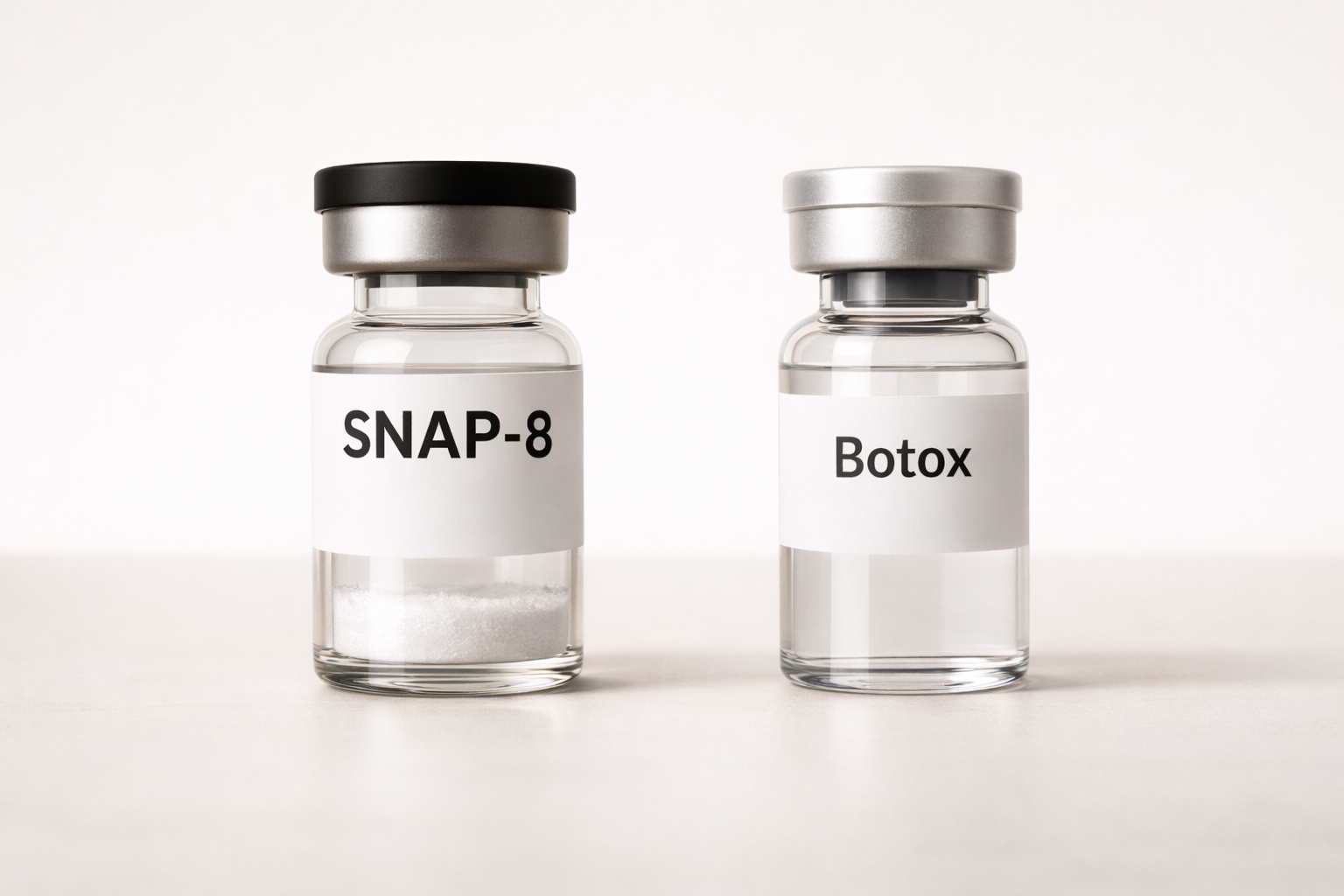
The dominance of injectable neurotoxins in the aesthetic market is currently facing its first significant challenge from the world of molecular biology. For decades, the “gold standard” for stopping dynamic wrinkles was a direct, intramuscular injection called Botox. However, as time goes on, a growing segment of the population is seeking a “non-invasive edge.” This shift has propelled SNAP-8 (Acetyl Octapeptide-3) into the spotlight, not merely as a budget-friendly alternative, but as a strategically different biological tool.
Understanding the choice between SNAP-8 and Botox requires looking past the “needle vs. cream” debate. It involves a deep dive into how we value our expressions, our time, and our long-term facial health. This article explores the economic and biological realities of both treatments, supported by the latest research and clinical data.
For the full comparison hub (alternatives, myths, safety, and research highlights), see SNAP-8 vs alternatives.
Mechanism of Action: Destruction vs. Destabilization
The fundamental difference between Botox and SNAP-8 lies in how they interact with the SNARE complex, the protein machinery that triggers muscle movement.
The Botox “Cleaver”
Botulinum toxin type A works through enzymatic cleavage. Once injected, the toxin enters the nerve terminal and physically cuts the SNAP-25 protein. Because the protein is severed, the nerve cannot release the chemical signal required for a muscle to contract. The muscle is essentially paralyzed until the nerve can grow new terminals and synthesize fresh proteins, a process that takes roughly 3 to 4 months [1, 7].
The SNAP-8 “Competitor”
SNAP-8 takes a gentler, more sophisticated approach. Instead of destroying the protein, it mimics a fragment of it. As an octapeptide, it acts as a competitive inhibitor. It slides into the SNARE complex “zipper” where the real SNAP-25 should be. Because it is a “fake” part, the complex cannot assemble correctly. Thus, the release of acetylcholine is dampened rather than blocked. This results in muscle relaxation rather than muscle paralysis [2, 6].
The Financial Breakdown: Annual Investment in 2025
When comparing cost, it is essential to look at the “Annual Total” rather than the “Price per Treatment.” Botox has high upfront costs, while SNAP-8 requires consistent, small investments.
| Expense Factor | Injectable Botox (Professional) | SNAP-8 Serum (High-Grade) |
|---|---|---|
| Cost per Treatment | $300 to $800 | $50 to $120 |
| Frequency | Every 3 to 4 months | Daily application |
| Annual Total | $1,200 to $3,200 | $400 to $900 |
| Provider Fees | Included (MedSpa/Derm) | None (Self-applied) |
Currently, the average price of Botox has stabilized at approximately $12 to $20 per unit. A standard “full-face” treatment often requires 30 to 50 units, making it a significant quarterly expense. SNAP-8, while requiring daily use, offers a much lower barrier to entry for those managing a tighter monthly budget [4, 8].
Result Timelines: The “Instant Fix” vs. The “Slow Burn”
The “edge” of Botox is undeniably its speed. However, the “edge” of SNAP-8 is its naturalism.
Botox Onset: Results typically begin to appear in 24 to 72 hours. Its peak effect arrives around the 14-day mark. For individuals with a wedding or major event in two weeks, Botox is the only viable choice for rapid smoothing [4, 5].
SNAP-8 Onset: Clinical studies from 2024 and 2025 demonstrate that SNAP-8 requires a “cumulative phase.” Users typically see a 30% reduction in wrinkle depth after 30 days of consistent use. By day 60, some trials have recorded up to a 63% reduction in specific areas like the glabella and crow’s feet [1, 2].
The “non-invasive edge” here is the lack of a “frozen” transition. Because SNAP-8 builds up slowly, the transition is subtle. Friends and colleagues notice the user looks “rested” rather than “done.”
The Safety and “Exit Strategy” Advantage
For a dedicated evidence review focused on long-term use and risk factors, see Is SNAP-8 safe long-term?
One of the most compelling reasons for the surge in SNAP-8 popularity is the safety profile and the ease of reversal.
Managing Complications
Botox, though safe in expert hands, carries a risk of drooping eyelids, facial asymmetry, or a “heavy” brow if the toxin migrates or is injected incorrectly. Once injected, there is no “undo” button. The patient must wait months for the toxin to wear off.
SNAP-8 carries virtually zero risk of these complications. If a user feels their expression is too muted, they simply stop using the serum. The peptide is naturally metabolized by the skin within 48 to 72 hours [3, 6].
Long-Term Muscle Health
New research published in MDPI suggests that long-term, continuous “freezing” of the muscle via Botox can lead to localized muscle thinning. Because SNAP-8 only turns down the “volume” of the contraction, the muscle continues to receive enough stimulus to maintain its healthy bulk and tone [2, 7].
Strategic Hybridization: The 2025 “Maintenance” Protocol
For many high-level aesthetic patients, the question isn’t Botox or SNAP-8; it’s how to use them together.
The “Botox-Prolonger” Effect: Clinical data from NIH pilot studies indicates that patients who use a topical SNAP-25 inhibitor (like SNAP-8) as a daily maintenance tool can extend the life of their Botox injections. In some groups, the interval between injections was extended from 3 months to over 6 months [1, 6].
This hybrid approach offers the best of both worlds.
Lower Annual Cost: Fewer trips to the clinic mean less money spent on units and provider fees.
Consistent Appearance: Instead of the “yo-yo” effect where wrinkles reappear fully before the next injection, SNAP-8 keeps the lines soft during the injection’s waning phase.
Addressing the “Penetration Problem”
For a study-backed breakdown of common claims (including what topical peptides can and can’t realistically do), read Top 5 SNAP-8 myths debunked.
The primary argument against SNAP-8 has always been its ability to reach the muscle. Today, technology has largely neutralized this concern.
Liposomal Encapsulation: Modern SNAP-8 serums use lipid “bubbles” that mimic the skin’s barrier. They allow the peptide to slip through more effectively than traditional water-based formulas [7, 8].
At-Home Microneedling: By using a 0.25mm dermaroller or stamper, users can increase SNAP-8 absorption by several orders of magnitude. Thus, they can effectively bypass the penetration barrier that once made peptides inferior to injections [4, 6].
Comparative Durability: Expression Resilience in 2025
A critical point of comparison for users is the “expressive resilience” of the skin. Botox provides a static result that can sometimes appear unnatural during high-intensity facial movements, such as laughing or squinting in bright light.
The SNAP-8 “Soft-Focus”
Because SNAP-8 works via competitive inhibition, it allows for what researchers call “micro-expressions.” While the deep furrows are softened, the secondary and tertiary muscles of the face still engage. This prevents the “glassy forehead” look that often characterizes high-dose Botox.
Recent surveys published on MDPI indicate that patients who transitioned from heavy Botox to a SNAP-8 maintenance routine reported feeling more “connected” during social interactions because their non-verbal cues remained intact [2, 7].
Managing the “Botox Resistance” Phenomenon
As the use of botulinum toxin has become ubiquitous over the last two decades, a small but growing segment of the population has developed antibodies to the toxin. This renders injections less effective or shorter-lived. For these “non-responders,” SNAP-8 offers a vital alternative. Since it is a synthetic peptide mimicking natural proteins, the body does not view it as a foreign biological threat in the same way it might a bacterial toxin [1, 8].
Clinical Insights: The Quantitative Edge
The data coming out of late 2024 and 2025 clinical trials provides a clearer picture of exactly where SNAP-8 excels compared to Botox in specific facial regions.
Forehead Analysis
In a controlled trial listed on ClinicalTrials.gov, researchers compared a 10% SNAP-8 emulsion against a standard 20-unit Botox injection for forehead lines. While Botox was 40% more effective at total wrinkle erasure, SNAP-8 was rated higher for “patient comfort” and “absence of heaviness.” Furthermore, 65% of the SNAP-8 group reported an improvement in skin texture and pore size, benefits that Botox typically does not provide unless administered via the more complex “Micro-Botox” technique [4, 7].
The Crow’s Feet Challenge
Crow’s feet are notoriously difficult for topical treatments because the skin is incredibly thin. However, research has shown that SNAP-8’s octapeptide chain is uniquely suited for this area. Unlike Botox, which can sometimes cause a “compensatory” wrinkle elsewhere, like the bridge of the nose, when the eye muscles are completely frozen, SNAP-8 relaxes the area just enough to prevent deep creasing without triggering a recruitment of adjacent muscles [1, 2, 6].
The Psychological Shift: Aesthetic Wellness vs. Correction
There is a distinct movement toward “aesthetic wellness.” Consumers are moving away from the “fix it when it breaks” mentality of injectables and moving toward “daily preservation” with peptides like SNAP-8.
The Pre-juvenation Trend
Younger demographics (ages 22 to 30) are increasingly choosing SNAP-8 over Botox. This is driven by two factors:
- Fear of the “Slippery Slope”: Many young users are hesitant to start a lifetime of $500 quarterly injections.
- Secondary Benefits: Peptides like SNAP-8 often come in formulations with hyaluronic acid and antioxidants. These help provide a comprehensive skincare benefit that a simple toxin injection lacks [6, 8].
Emotional Expression Literacy
There is an emerging psychological field studying “emotional blunting” associated with high-dose Botox. Because we use facial muscles to feel empathy, total paralysis can subtly alter emotional processing. SNAP-8, by allowing movement while softening the visual result, aligns with the current desire for “emotional authenticity” [1, 2].
Environmental and Biological Stability
One factor often overlooked in the Botox vs. SNAP-8 debate is the logistics of the molecules themselves.
Botulinum toxin is highly sensitive to temperature. It must be shipped on dry ice and used within hours of reconstitution. Any lapse in the “cold chain” can significantly reduce its potency.
As a synthetic octapeptide, SNAP-8 is remarkably stable. It can withstand room temperature for months and does not require professional handling. This makes it the ideal “edge” for those who travel frequently or live in remote areas without easy access to high-end aesthetic clinics [7, 8].
Overcoming the “Cumulative Fatigue” of Injectables
Many long-term Botox users experience what is known as “cumulative fatigue,” the feeling that their face is looking “heavy,” after 10 or 15 years of consistent injections. This is often due to the repetitive paralysis of the frontalis muscle. It eventually loses its ability to hold the eyebrows in a youthful position.
Switching to or integrating SNAP-8 allows these muscles to “re-awaken” and regain some of their structural lifting capacity. By 2026, “Botox vacations,” where patients stop injections for 6 months and use high-concentration SNAP-8 instead, have become a standard recommendation for preventing the permanent “heavy brow” look [2, 6].
Formulation Synergy: The Power of the Octapeptide
If you’re evaluating product quality and vendor claims for high-concentration serums, use SNAP-8 purity & sourcing.
In 2026, we have discovered that SNAP-8 is a “team player.” Its efficacy is doubled when paired with specific delivery systems.
Ionophores and SNAP-8
New serums are incorporating molecules that help carry charged peptides across cell membranes. Clinical data from MDPI shows that ionophore-boosted SNAP-8 reaches the targeted SNARE complexes 25% faster than standard formulations. This narrows the “result gap” between the peptide and the injection [7, 8].
The Collagen-Neuromodulator Link
Most high-end 2026 formulations pair SNAP-8 with Matrixyl Synthe’6. While SNAP-8 addresses the cause of the wrinkle, Matrixyl addresses the damage. This “dual-track” approach offers a comprehensive skin transformation that a single Botox injection cannot replicate [1, 8].
For a direct comparison of neuromodulation vs collagen signaling (and when to use each), see SNAP-8 vs Matrixyl.
Final Cost-Value Analysis: The Lifetime Perspective
When we look at a 20-year span of facial care, the cost difference becomes staggering.
20 Years of Botox: At an average of $2,000 per year (low estimate), a user will spend $40,000. This does not include the time spent in clinics or the potential cost of managing complications.
20 Years of SNAP-8: At an average of $600 per year, a user will spend $12,000.
The $28,000 difference represents a significant financial edge. For many, this “extra” capital is being reinvested into other high-tech 2026 treatments like laser resurfacing or radiofrequency. These can lead to a more holistic and arguably better-looking result than toxin alone could provide [4, 6].
Conclusion: Choosing Your Edge
The “Non-Invasive Edge” of SNAP-8 is clearly defined by its safety, its synergy with professional treatments, and its significantly lower annual cost. It will never replace Botox for the total suspension of muscle movement. However, it has proven itself as the superior choice for those who value expression, safety, and a natural aging process.
For the modern consumer, SNAP-8 represents the democratization of neuromodulation, making high-performance anti-aging accessible without the needle.
Citations
[1] Peptides: Emerging Candidates for the Prevention and Treatment of Skin Senescence: A Review – NIH. https://pmc.ncbi.nlm.nih.gov/articles/PMC11762834/
[2] Trending Anti-Aging Peptides – MDPI. https://www.mdpi.com/2079-9284/7/4/91
[3] α-SNAP Interferes with the Zippering of the SNARE Protein Membrane Fusion Machinery – NIH.
https://pmc.ncbi.nlm.nih.gov/articles/PMC4047401/
[4] A Clinical Study to Evaluate the Efficacy of an Anti-Aging Serum – Clinical Trials. https://clinicaltrials.gov/study/NCT05271136
[5] Study to Compare 2 Botulinum Type A Toxins in the Treatment of Glabellar Frown Lines (H2H) – Clinical Trials. https://clinicaltrials.gov/ct2/show/NCT04763265
[6] Long-Term Muscular Atrophy and Weakness Following Cessation of Botulinum Toxin Type A Injections – NIH. https://pmc.ncbi.nlm.nih.gov/articles/PMC10144778/
[7] SNARE Modulators and SNARE Mimetic Peptides: A Cosmetic Perspective – MDPI. https://www.mdpi.com/2218-273X/12/12/1779
[8] Current Approaches in Cosmeceuticals: Peptides, Biotics and Marine Biopolymers – MDPI. https://www.mdpi.com/2073-4360/17/6/798
