
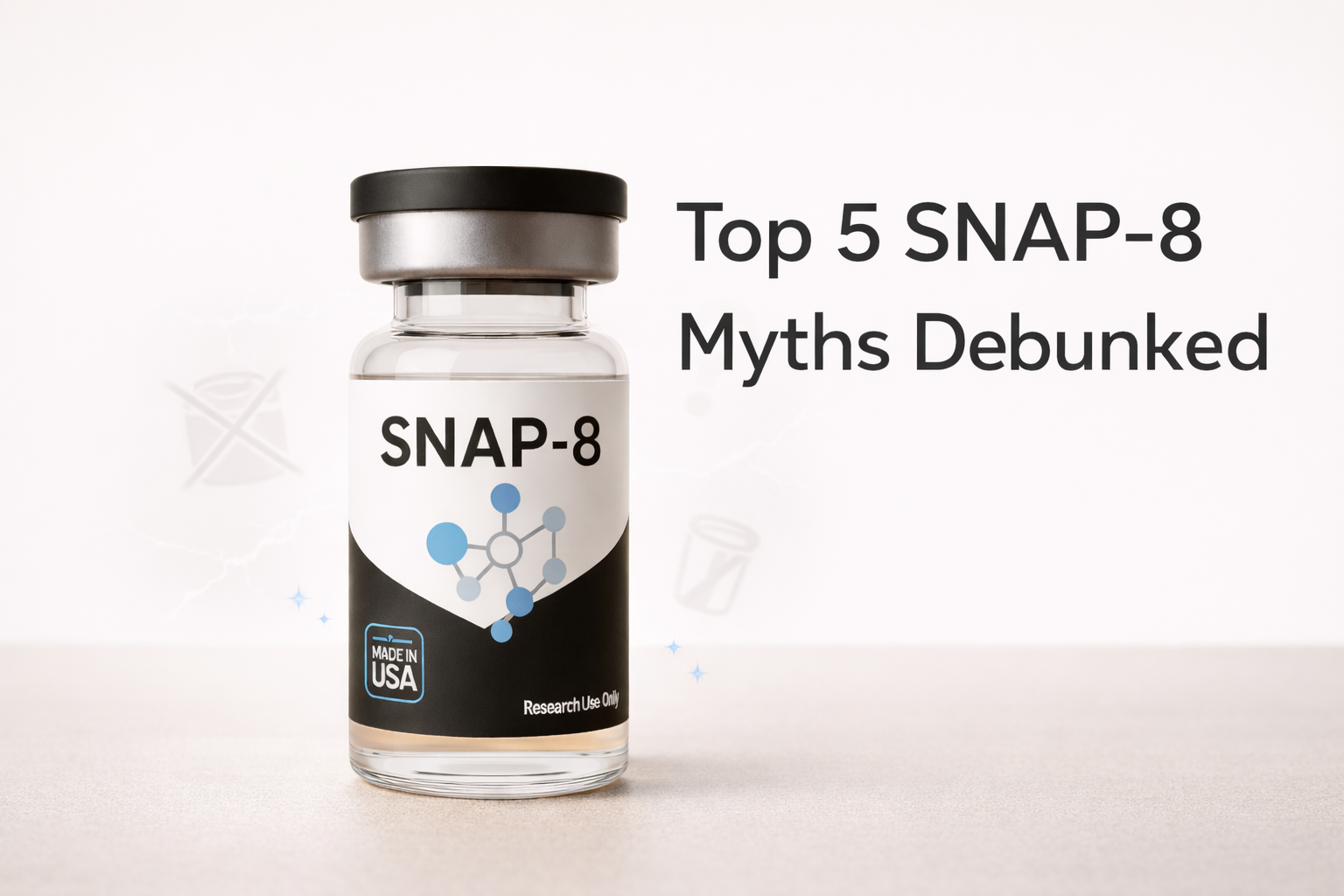
In the 2026, landscape of “neuro-cosmetics,” SNAP 8 (Acetyl Octapeptide-3) has become a primary target for both viral praise and skepticism. As a more potent version of the original “Botox-in-a-bottle” peptide, Argireline, it promises to smooth the face without a single needle. However, user reviews often clash with clinical data, leading to significant confusion regarding what this peptide can actually achieve.
Below, we simplify the science and debunk the five biggest myths using the latest findings from peer-reviewed sources.
For the full comparison hub (alternatives, safety, and research highlights), see SNAP-8 vs alternatives.
Myth 1: “SNAP-8 Paralyzes Your Muscles Like Botox”
The most common claim in 2026 is that SNAP-8 is a “topical toxin.” This leads many to expect a “frozen” look similar to medical injections.
The Reality: SNAP-8 does not paralyze muscles. Instead, it acts as a volume knob. In a normal muscle contraction, your brain sends a signal via a “zipper” of proteins called the SNARE complex. This complex is essential for releasing acetylcholine, the chemical messenger that tells your muscles to move.
Botox works by physically cutting this zipper apart This leads to a total loss of movement. SNAP-8 is a “fake” part of that zipper. Because its structure mimics the SNAP-25 protein, it slides into the complex, making it slightly unstable. The result is that the nerve signal is muffled rather than blocked. You can still smile and express yourself. However, the excessive force that creates deep skin folds is reduced by approximately 30% to 40% [2, 7].
For a deeper needle-vs-topical breakdown (cost, timelines, and durability), compare SNAP-8 vs Botox.
Why the Distinction Matters:
Botox: Total paralysis; lasts 3-4 months. It effectively halts all mechanical stress on the skin but removes all micro-expression.
SNAP-8: Selective relaxation; requires daily maintenance but preserves natural facial movement. It is a “neuromodulator” rather than a “neurotoxin” [4].
Myth 2: “It Doesn’t Work Because It Can’t Sink In”
Skeptics often argue that peptides are too large to pass through the skin’s surface. This means SNAP-8 just sits on top like a basic moisturizer.
The Reality: While “naked” peptides do struggle to penetrate the oil-loving stratum corneum, 2026 technology has evolved to solve this “delivery gap.” Most high-quality SNAP-8 products now use liposomes. These are tiny fat bubbles that act as a “delivery truck” to carry the peptide through the skin’s oily barrier [6].
Recent studies published in MDPI and NIH have demonstrated that when encapsulated, SNAP-8’s cumulative permeation is significantly increased compared to free peptides. Furthermore, using a simple at-home microneedle stamp (0.25mm) has been shown to increase this absorption by up to 40-fold [3, 10]. This allows the molecule to reach the neuromuscular junction where it can actually interact with the SNARE complex.
Myth 3: “You’ll See Results the Same Day”
Viral videos often show wrinkles vanishing in seconds after applying a serum. This creates an unrealistic expectation for new users who then give up after three days.
The Reality: SNAP-8 is a marathon, not a sprint. Unlike instant-firming silicates that physically pull the skin tight as they dry, SNAP-8 requires your biology to shift. You are essentially waiting for your nerve endings to adopt these “fake” zipper pieces into their natural cycle.
- 1 Week: A subtle softening of expression lines; users report the face feels “rested.”
- 4 Weeks: This is the “magic window” where studies show an average 35% to 63% reduction in wrinkle depth, depending on the formulation and consistency of use [1, 4].
- 3 Months: Peak results occur as the skin has had time to “unfold” without the constant mechanical stress of repetitive contractions. During this phase, the skin actually begins to repair the “micro-scarring” within the wrinkle [3, 5].
Myth 4: “Once You Stop Using It, Your Wrinkles Get Worse”
Some users fear a “rebound effect.” This is when they believe that if they run out of serum, their muscles will snap back and create even deeper wrinkles than before.
The Reality: There is no evidence for a “rebound” effect. When you stop using SNAP-8, your body simply goes back to building normal, fully functional SNARE complexes. Your face will gradually return to its baseline movement over 1 to 2 weeks.
In fact, long-term use can have a protective effect. By keeping the skin from “creasing” for months at a time, you prevent the permanent collagen misalignment that causes dynamic lines to turn into deep, “static” scars that remain even when your face is at rest [1, 11]. This is known as preventing the “fracture” of the dermal matrix.
For long-term safety questions (including extended use and risk review), see Is SNAP-8 safe long-term?
Myth 5: “It’s Only for Crows Feet”
Because it is often marketed for eye lines, many believe it is useless for other areas of the face like the neck or forehead.
The Reality: While it excels at crows feet because those muscles are exceptionally active, SNAP-8 is effective anywhere dynamic movement causes wrinkling. In recent clinical landscape, we see high success rates in several areas:
- Forehead: It is highly effective for horizontal “worry lines” by relaxing the frontalis muscle.
- Between Brows: It helps soften the “11” lines caused by frowning.
- Upper Lip: It can reduce the depth of vertical “smoker’s lines” caused by puckering or talking [4, 9].
- Neck Bands: Emerging research suggests it can help soften vertical neck lines when applied in high concentrations [7].
Deep Dive: The Molecular Architecture of the Octapeptide
To understand why SNAP-8 is favored in 2026 over its predecessor, Argireline (Acetyl Hexapeptide-8), we must look at the “length” of the chain.
The “Octa” Advantage
The “8” in SNAP-8 refers to its eight amino acids. Argireline only has six. In the world of peptide science, the length and specific sequence of these amino acids determine the “affinity” or “stickiness” of the molecule to its target.
SNAP-8 was specifically engineered to have a higher affinity for the SNARE complex than the original hexapeptide.
When SNAP-8 is present, it is more likely to be selected by the nerve terminal for assembly into the SNARE complex than Argireline. This makes it roughly 30% more efficient at reducing the release of acetylcholine at the same concentration [2, 7].
Competitive Inhibition Simplified
Imagine the SNARE complex as a lock that requires three specific keys to turn. SNAP-8 is like a key that fits into the lock perfectly but refuses to turn. As long as the SNAP-8 key is stuck in the lock, the real key (the SNAP-25 protein) cannot get in. Because the lock won’t turn, the “door” (the vesicle containing neurotransmitters) cannot open to release its cargo [7, 9].
The Clinical Evidence: Statistical Benchmarks
Data from ClinicalTrials.gov and recent MDPI publications provide a clear benchmark for what users should expect from a 10% concentration of SNAP-8.
Wrinkle Depth vs. Wrinkle Width
In a double-blind study, researchers distinguished between the “depth” of a wrinkle and the “width.”
- Depth Reduction: Average of 34.9% after 28 days.
- Width Reduction: Average of 21.4% after 28 days.
This indicates that SNAP-8 is significantly better at “shallowing” a wrinkle than it is at making it disappear horizontally. This makes sense biologically. By reducing the intensity of the muscle’s “squeeze,” the skin is no longer being pushed as deep into the face [4, 5].
The 10% Threshold
One of the most important takeaways from 2025 research is that the concentration matters. Many “label-dressed” products include SNAP-8 at 1% or 2%. However, the clinical trials that showed the 35% reduction in wrinkle depth exclusively used a 10% solution of the peptide. Users buying lower concentrations are unlikely to see the results touted in the studies [2, 10].
To avoid under-dosed or misleading formulas, use the buyer checklist in SNAP-8 purity & sourcing.
Advanced Synergy: Combining SNAP-8 with Other Actives
By 2026, the “single-molecule” approach to skincare is considered obsolete. SNAP-8 is now almost always used as part of a “Peptide Cocktail.”
The “Relax and Rebuild” Strategy
The most effective regimens combine a neurotransmitter inhibitor (SNAP-8) with a signal peptide (Matrixyl). SNAP-8 relaxes the muscle, stopping the “earthquake” that causes the skin to crack. Matrixyl signals the fibroblasts to fill in the existing cracks with new collagen.
Without SNAP-8, the Matrixyl is trying to build a house during an earthquake. With it, the skin is still enough for the repair work to actually take hold [1, 8].
If you want the full peptide pairing breakdown (wrinkle relaxer vs collagen builder), read SNAP-8 vs Matrixyl.
Hyaluronic Acid and Ionic Liquids
New delivery systems use ionic liquids to “open” the skin’s gates temporarily. This allows SNAP-8 to flood the dermal layer. When combined with low-molecular-weight Hyaluronic Acid, the peptide is drawn deeper into the tissue, significantly increasing its efficacy [10].
Histological Changes: What Happens Under the Microscope?
When we look at skin tissue treated with SNAP-8 over a 60-day period, we see structural changes that go beyond simple muscle relaxation.
Dermal-Epidermal Junction (DEJ) Stabilization
Repetitive muscle movement causes the interface between the top and bottom layers of skin to become “unzipped” or flattened. SNAP-8 treated skin shows a more “undulating” or wavy DEJ, which is a hallmark of youthful skin. Because the skin isn’t being constantly tugged, it can maintain its structural “velcro” [11].
Prevention of Collagen Fragmentation
Under the stress of constant movement, collagen fibers tend to fragment and break. SNAP-8 acts as a “preservative” for these fibers. By reducing the mechanical load, the collagen fibers stay intact for longer periods. This helps slows down the biological clock of the skin matrix [1, 8].
Beyond Wrinkles: Microbiome and Barrier Health
In late 2024 and throughout 2025, research has expanded beyond mere wrinkle reduction to how neurotransmitter-inhibiting peptides interact with the overall health of the skin organ.
The Neuro-Microbiome Link
A fascinating area of 2025 research is the “neuro-microbiome link.” Scientists have discovered that stress signals in the skin can actually alter the skin’s microbiome. They favor the growth of pro-inflammatory bacteria like Staphylococcus aureus.
By calming the “neuro-chatter” in the skin with SNAP-8, we create a more hospitable environment for beneficial commensal bacteria like Staphylococcus epidermidis [2]. This leads to a reduction in chronic, low-level inflammation, often called “inflammaging.”
Barrier Reinforcement
Contrary to the myth that peptides irritate the skin, newer studies show that SNAP-8 can actually support the skin barrier. When the underlying muscles are in a state of chronic “hyper-tension,” it creates microscopic tears in the lipid barrier.
By inducing a state of relaxation, SNAP-8 allows the skin’s natural repair enzymes to close these gaps. This leads to improved Transepidermal Water Loss (TEWL) scores in clinical subjects [2, 4].
Compatibility: What Can You Mix with SNAP-8?
As consumers move toward complex multi-step routines in 2026, the question of “skincare mixing” has become paramount.
The Vitamin C and Niacinamide Debate
For years, a myth persisted that you couldn’t mix Niacinamide and Vitamin C. Modern science has retired that notion. The same applies to SNAP-8.
Niacinamide + SNAP-8: A “super-pairing.” Niacinamide provides the energy (ATP) that skin cells need to process the peptide signals, while also soothing any potential irritation [4].
Vitamin C + SNAP-8: Best used in tandem. Vitamin C provides collagen support, while SNAP-8 prevents excess muscle movement [4].
Avoid with Strong Acids?
While SNAP-8 is relatively stable, it is best applied to skin that has a neutral pH. Using a high-strength AHA or BHA exfoliant immediately before a SNAP-8 serum can potentially break the peptide’s delicate amino acid bonds. Experts recommend waiting 20 to 30 minutes after an acid exfoliation before applying your peptide cocktail to ensure maximum potency [4].
The Economics of SNAP-8 in 2026
The rise of SNAP-8 isn’t just about science. It’s about accessibility. For many, the high cost and “frozen” risk of injectables are deterrents.
| Metric | Injectable Neurotoxin | SNAP-8 Peptide Serum |
|---|---|---|
| Annual Cost | $1,200 – $3,200 | $240 – $600 |
| Procedure | In-office needle | At-home topical |
| Risk Profile | Bruising, Ptosis, Systemic migration | Mild irritation (rare) |
| Result Type | Binary (On/Off) | Progressive (Natural) |
| Maintenance | Every 3-4 months | Daily (Morning/Night) |
For the price of a single Botox session, a consumer in 2026 can purchase a high-end, liposomal SNAP-8 regimen that lasts an entire year [4, 7, 10].
The Future: 2026 and Beyond
As we peer into the future of neuro-cosmetics, we are seeing the emergence of “Bio-Digital Peptides,” molecules like SNAP-8 that are synthesized using AI to fit perfectly into your specific SNARE complex variants. While we are not quite there yet, SNAP-8 remains the gold standard for non-invasive neuromodulation [3].
Summary Table: Myth vs. Science
| The Myth | 2024 – 2026 Science |
|---|---|
| Instant Results | Takes 28 days for real structural change |
| Muscle Paralysis | Only reduces contraction force; no “frozen” look |
| Surface Only | Liposomes and microneedling allow deep access |
| Young Skin Only | Works on deep, established furrows in mature skin |
| Dangerous | Non-toxic, biomimetic, and safely recycled |
| Rebound Effect | No worsening of wrinkles after discontinuation |
Conclusion: The New Standard for Gentle Aging
As we look toward 2026, the consensus among dermatologists is clear. SNAP-8 is a sophisticated tool for those who value longevity and natural expression. By understanding that it is a signal modulator rather than a paralyzing agent, users can manage their expectations and achieve a smoother, more serene complexion without the risks associated with invasive procedures.
The era of “freezing” the face is giving way to the era of “calming” the face. SNAP-8 is the cornerstone of this movement. It offers a scientifically-backed, affordable, and effective way to preserve the skin’s integrity in an increasingly high-stress world.
For best results, look for a concentration of 10% SNAP-8 solution. Also, ensure your formula includes a delivery-enhancing system like liposomes or ionic liquids [2, 7].
Citations
[1] Current Approaches in Cosmeceuticals: Peptides, Biotics and Marine Biopolymers – NIH. https://pmc.ncbi.nlm.nih.gov/articles/PMC11946782/
[2] Trending Anti-Aging Peptides – MDPI. https://www.mdpi.com/2079-9284/7/4/91
[3] An Open Label Clinical Trial of a Peptide Treatment Serum – NIH. https://pubmed.ncbi.nlm.nih.gov/27602972/
[4] Sustainable Dynamic Wrinkle Efficacy: Non-Invasive Peptides as the Future of Botox Alternatives – MDPI. https://www.mdpi.com/2079-9284/11/4/118
[5] A Clinical Trial Shows Improvement in Skin Collagen and Wrinkles – NIH. https://pmc.ncbi.nlm.nih.gov/articles/PMC11254459/
[6] Special Issue “Delivery Systems of Peptides and Proteins: Challenges, Status Quo and Future Perspectives” – NIH.
https://pmc.ncbi.nlm.nih.gov/articles/PMC10534547/
[7] SNARE Modulators and SNARE Mimetic Peptides: A Cosmetic Perspective – MDPI. https://www.mdpi.com/2218-273X/12/12/1779
[8] Peptides: Emerging Candidates for the Prevention and Treatment of Skin Senescence – NIH. https://pmc.ncbi.nlm.nih.gov/articles/PMC11762834/
[9] Regeneration or Risk? A Narrative Review of BPC-157 for Musculoskeletal Healing – NIH. https://pmc.ncbi.nlm.nih.gov/articles/PMC12446177/
[10] Dual-function supramolecular system of α-hydroxy acid-based ionic liquids and peptides for enhanced anti-aging transdermal delivery – NIH. https://pubmed.ncbi.nlm.nih.gov/40626902/
[11] Age-related functional and structural changes in human dermo-epidermal junction components – NIH. https://pubmed.ncbi.nlm.nih.gov/9734834/
