
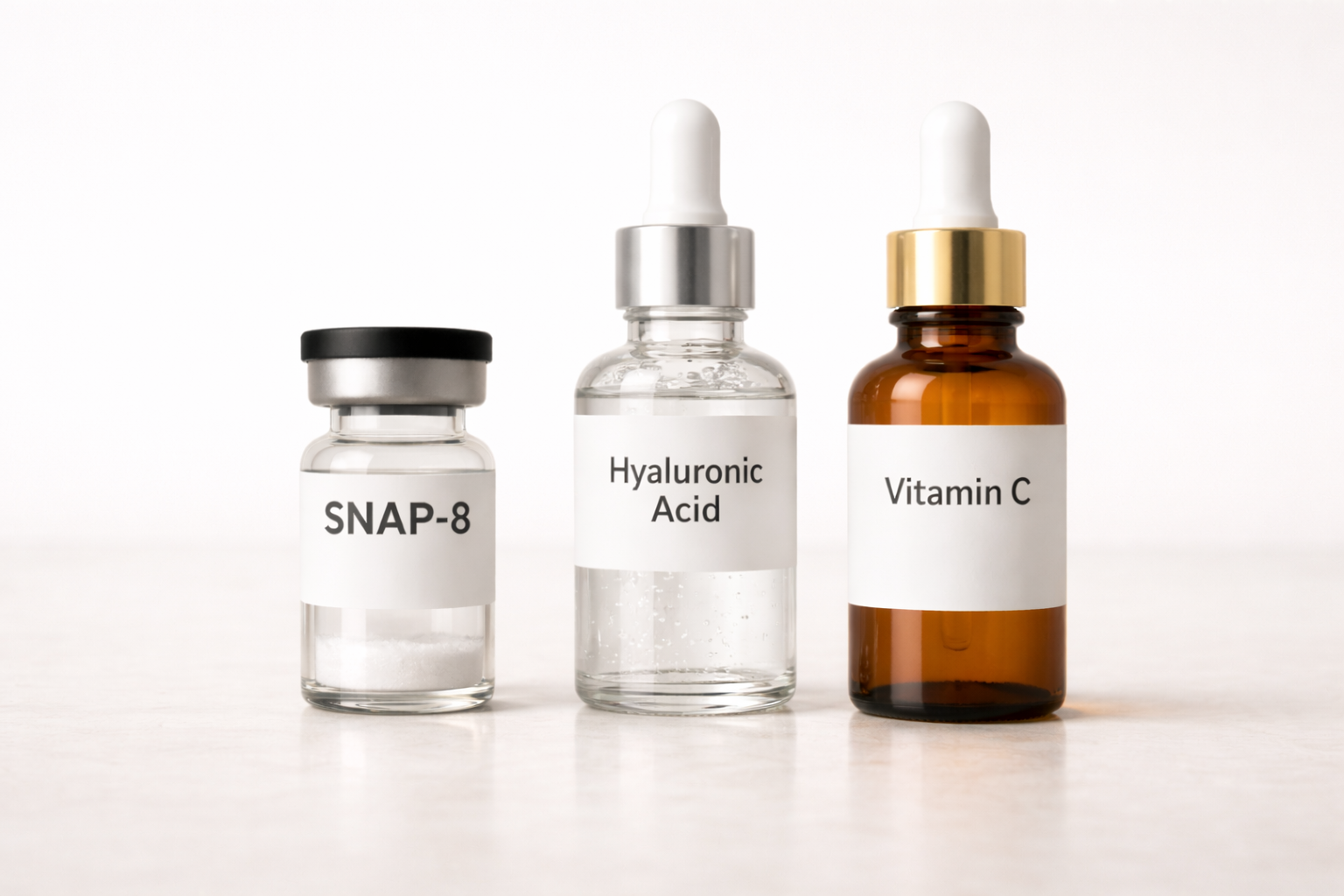
The modern skincare landscape is no longer about finding a single “miracle” ingredient. Instead, it is about the art of the “stack.” Stacking involves combining powerful biological actives, allowing them to work harder together than they ever could alone. At the heart of this high-performance strategy is SNAP-8 peptide (Acetyl Octapeptide-3). This top-tier peptide is designed to help relax the appearance of expression lines.
While SNAP-8 is impressive on its own, its true potential is unlocked when paired with two legendary companions: Hyaluronic Acid (HA) and Vitamin C (L-Ascorbic Acid). This specific trio addresses hydration, protection, and structural integrity. By understanding the science of how these ingredients interact, you can transform a simple routine into a professional-grade skin rejuvenation system.
For a complete system covering timing, cycling, penetration, and advanced techniques, follow Advanced SNAP-8 routines.
The Power of Three: Why This Stack Works
To appreciate the synergy of this combination, we must look at how each ingredient occupies a different “functional niche” within the skin.
SNAP-8: The Expression Modulator
SNAP-8 belongs to a class of peptides known as neurotransmitter inhibitors. It works by interfering with the SNARE complex. This group of proteins is required for the release of chemicals that tell your muscles to contract. By “muffling” these signals, SNAP-8 helps the skin remain smooth during facial expressions. It prevents the mechanical creasing that leads to deep wrinkles over time [1, 6].
Hyaluronic Acid: The Hydration Engine and Penetration Aide
Hyaluronic Acid is a humectant capable of holding up to 1,000 times its weight in water. Beyond its obvious plumping effects, HA plays a crucial role in “Active Transport.” When the skin is fully hydrated, the spaces between skin cells become more fluid. This makes it significantly easier for larger molecules, like the SNAP-8 peptide, to migrate deeper into the skin [5, 8].
Vitamin C: The Structural Guardian
While SNAP-8 manages muscle movement and HA manages water, Vitamin C manages the “scaffold” of the skin. As a powerful antioxidant, it neutralizes free radicals from UV light and pollution. More importantly, it is a mandatory co-factor for the enzymes that produce collagen. Without Vitamin C, your skin cannot effectively repair the structural damage that SNAP-8 is trying to prevent [4, 7].
Synergy Tip #1: The “Water Bridge” Effect
The most significant benefit of stacking SNAP-8 with Hyaluronic Acid is the improvement in bioavailability.
Peptides are notoriously difficult to deliver into the skin. They are relatively large and water-loving, while the skin’s surface is oily. Hyaluronic Acid acts as a “Water Bridge.” By saturating the outermost layer of skin with moisture, HA creates a conductive environment.
Apply your Hyaluronic Acid serum to slightly damp skin first. Before it completely dries, apply your SNAP-8 serum. The HA will “pull” the peptide molecules along with the water as it absorbs. This ensures that the SNAP-8 reaches the deeper layers where the nerve-to-muscle junctions are located [5, 8].
Synergy Tip #2: Vitamin C as a Collagen Catalyst
Because absorption and compatibility vary by time of day, this timing breakdown on best time to apply SNAP-8 helps refine when to layer each active.
If SNAP-8 is the “preventative” measure that stops new wrinkles from forming, Vitamin C is the “restorative” measure that repairs existing ones.
Research published in the National Institutes of Health (NIH) and MDPI highlights that combined treatments of peptides and Vitamin C significantly attenuate age-related skin atrophy. Vitamin C stabilizes the collagen tertiary structure and promotes collagen gene expression [4, 7].
Use Vitamin C in the morning to take advantage of its photoprotective properties. When SNAP-8 and Vitamin C are used in the same morning routine, you are effectively protecting your collagen from two sides. The Vitamin C protects it from environmental degradation, while the SNAP-8 protects it from the mechanical stress of facial contractions [1, 4].
The Golden Rule of pH Layering
One of the most common mistakes in “stacking” is ignoring the pH levels of your products. Ingredients that are too acidic can actually “unravel” or denature delicate peptides like SNAP-8.
- Vitamin C (Pure L-Ascorbic Acid): Usually requires a low, acidic pH (around 3.0 to 3.5) to be effective.
- SNAP-8: Is most stable at a more neutral pH (between 5.0 and 6.0).
If you apply them at the exact same second, the acidity of the Vitamin C may compromise the structure of the SNAP-8 peptide.
The Pro Tip: After applying your Vitamin C serum, wait approximately 5 to 10 minutes for the skin’s pH to naturally begin its return to a neutral state before applying your SNAP-8 and Hyaluronic Acid. This ensures both ingredients remain chemically active [4, 6].
Advanced Dermal Remodeling: The SNAP-8 and Vitamin C Connection
Beyond just protection, the combination of SNAP-8 and Vitamin C triggers a process called “dermal remodeling.” While SNAP-8 focuses on the neuromuscular junction to relax the skin’s surface, Vitamin C works deep within the “factory cells” of your skin.
The Stability Factor
One of the biggest hurdles with Vitamin C is its instability. It oxidizes quickly when exposed to air and light. Interestingly, some research suggests that when peptides are present in a formulation or applied shortly after, they can help create a more supportive environment for the skin’s antioxidant network. By reducing the “mechanical stress” on the skin through SNAP-8, the skin’s repair enzymes (which are fueled by Vitamin C) can focus on rebuilding the matrix rather than simply managing the damage from constant folding and creasing [7, 8].
Creating “Stable” Collagen
Not all collagen is created equal. Vitamin C is a required co-factor for the enzymes prolyl hydroxylase and lysyl hydroxylase. These enzymes are responsible for cross-linking collagen fibers to give them their “triple helix” strength. Without enough Vitamin C, the collagen your skin produces is “loose” and fragile. When you stack SNAP-8 with a high-quality Vitamin C, you are ensuring that the skin remains smooth (via SNAP-8). You also ensure that the underlying foundation is physically strong enough to resist future sagging [4, 7].
The Role of Molecular Weight in the HA-Peptide Stack
Not all Hyaluronic Acid is the same, and the type you choose dramatically changes how SNAP-8 performs.
Low Molecular Weight HA (LMW-HA)
LMW-HA has smaller molecules that can penetrate deeper into the skin. When used as a base for SNAP-8, it acts as a “delivery vehicle.” Because SNAP-8 is a large octapeptide, it often hitches a ride with the LMW-HA as it travels through the epidermis. This is the “pulling” effect mentioned in the Water Bridge section. It is most effective when the HA molecules are small enough to move through the skin’s cellular gaps [5, 8].
High Molecular Weight HA (HMW-HA)
HMW-HA stays on the surface of the skin, forming a protective, hydrating film. This is vital for the “Morning Shield.” By keeping the surface hydrated, it prevents the SNAP-8 from drying out and becoming inactive before it has a chance to absorb. For the best results, look for a “Multi-Molecular” HA serum that contains both types [2, 8].
Troubleshooting Your Stack: Environmental Factors
Your environment can be just as influential as your products. The synergy between Vitamin C and SNAP-8 is particularly sensitive to external stressors.
HIn very dry climates, Hyaluronic Acid can actually pull moisture out of your skin if there isn’t enough moisture in the air. To keep your SNAP-8 stack working, always apply a moisturizer or “occlusive” over your serums. This can help trap the water and the peptides inside [5].
Vitamin C is light-sensitive. If you are stacking these in the morning, your sunscreen is the “lock” that keeps the ingredients active. Without SPF, the UV rays will degrade the Vitamin C and cause micro-inflammations that can break down the SNAP-8 peptide chains [3, 7].
Long-Term Expectations: The Cumulative Effect
When you start stacking these three actives, the timeline of your results changes. You are no longer just looking for a “plumping” effect. You are looking for a structural shift in how your skin behaves.
- Month 1 (The Smoothing Phase): Thanks to the Hyaluronic Acid and the initial muscle-relaxing effect of SNAP-8, you will see an immediate boost in “glow” and a softening of fine lines.
- Month 3 (The Repair Phase): This is where Vitamin C shines. By the 90-day mark, the increased collagen production starts to become visible. The skin feels “thicker” and more resilient. The deep expression lines targeted by SNAP-8 appear significantly shallower because the skin is no longer being folded as aggressively [1, 6].
- Month 6 and Beyond (The Maintenance Phase): At this stage, your skin has reached a new “baseline.” The synergy of the stack has successfully slowed the rate of mechanical aging and environmental aging [4, 8].
Once your skin reaches a new baseline, structured phases outlined in cycling SNAP-8 help maintain results without diminishing returns.
Maximizing Bio-Availability through Skin Temperature
For penetration beyond topical diffusion alone, review the protocols for microneedling with SNAP-8.
An often-overlooked factor in stacking success is the physical state of the skin during application. Biological research indicates that skin temperature fluctuates in accordance with the circadian rhythm, peaking in the evening [3, 5].
The Pro-Absorption Tip: To maximize the penetration of your SNAP-8 and Hyaluronic Acid stack at night, apply your products immediately after a warm shower. The localized heat causes widening of the blood vessels and increases the fluidity of the skin’s lipid barrier. This “warm skin” state significantly lowers the resistance that large molecules like SNAP-8 encounter when moving through the epidermis.
Beyond the Surface: The Cellular “Bio-Feedback” Loop
When you stack SNAP-8 with HA and Vitamin C, you aren’t just layering liquids; you are initiating a bio-feedback loop within the skin’s cells.
Step 1: SNAP-8 reduces the mechanical stress on the cells by relaxing muscle pull.
Step 2: Hyaluronic Acid ensures the fluid around the cells is rich in moisture. This helps facilitate cellular communication.
Step 3: Vitamin C provides the energy and raw materials needed for cellular repair.
This loop creates an environment where the skin can “rest” and “rebuild” simultaneously. In the absence of this stack, the skin is often in a state of constant high-tension and low-resource (due to antioxidant depletion). By providing all three tools, you shift the skin from a “survival state” to a “thriving state.”
Compatibility and Conflicts: What to Exclude
While our “Power Trio” is highly synergistic, it can be disrupted by the introduction of certain other ingredients. To maintain the integrity of your SNAP-8 stack, keep the following in mind:
If retinoids are part of your routine, follow the dedicated safety guidance for SNAP-8 with retinol to avoid irritation or peptide instability.
Direct Acids (Glycolic/Salicylic): If used in the same step, these can lower the pH so significantly that they break the peptide bonds in SNAP-8. Use your acids on alternate nights or ensure a significant wait time [6].
Copper Peptides: While great for the skin, copper peptides can actually oxidize Vitamin C if mixed directly. It is best to use Copper Peptides and Vitamin C at different times of the day [4, 7].
Heavy Silicones: Some low-cost HA serums use heavy silicones to give a “silky” feel. These can act as a barrier, preventing SNAP-8 from reaching the skin. Look for “clean” aqueous formulas for your stacking steps.
The Step-by-Step Stacking Routine
To get the most out of these three ingredients, follow this specific order of operations to maximize absorption and minimize irritation.
The Morning “Defense” Stack
- Use a gentle, pH-balanced cleanser.
- Apply vitamin C to dry skin to ensure maximum antioxidant contact.
- Wait 5 minutes for the pH to stabilize.
- Lightly dampen the skin with water or a thermal mist.
- Apply hyaluronic acid to the damp skin to lock in moisture.
- Immediately apply your SNAP-8 serum, using the “Press and Hold” technique on expression-prone areas.
- Finish with a broad-spectrum sunscreen.
The Evening “Recovery” Stack
- Remove the day’s pollutants through a double cleanse.
- Apply hyaluronic acid to damp skin.
- Layer SNAP-8 generously over the HA. At night, your skin’s permeability is higher. This makes it the best time for peptide penetration [3, 5].
- Use a moisturizer or facial oil to create an “occlusive seal.” This will help trap the actives against the skin for the duration of your sleep.
Conclusion: The Art of Skincare Synergy
Stacking SNAP-8 with Hyaluronic Acid and Vitamin C is more than just a trend. It is a scientifically backed approach to anti-aging. By utilizing Hyaluronic Acid as a delivery vehicle, Vitamin C as a structural rebuilder, and SNAP-8 as a mechanical relaxant, you are addressing every major cause of wrinkle formation.
Remember, the goal is not to overwhelm the skin. The goal is to provide it with the right tools at the right time. Respect the pH levels, embrace the moisture, and stay consistent. Over time, this “Power Trio” will reward you with skin that isn’t just younger-looking, but fundamentally healthier and more resilient.
Citations
[1] Trending Anti-Aging Peptides – MDPI. https://www.mdpi.com/2079-9284/7/4/91
[2] Sustainable Dynamic Wrinkle Efficacy: Non-Invasive Peptides as the Future of Botox Alternatives – MDPI. https://www.mdpi.com/2079-9284/11/4/118
[3] The molecular clock in the skin, its functionality, and how it is disrupted – NIH. https://pmc.ncbi.nlm.nih.gov/articles/PMC11105295/
[4] Effectiveness of a formulation containing peptides and vitamin C in treating signs of facial ageing: three clinical studies – NIH. https://pmc.ncbi.nlm.nih.gov/articles/PMC8247005/
[5] Biological Rhythms in the Skin – NIH. https://pmc.ncbi.nlm.nih.gov/articles/PMC4926335/
[6] An Open Label Clinical Trial of a Peptide Treatment Serum and Supporting Regimen Designed to Improve the Appearance of Aging Facial Skin – NIH. https://pubmed.ncbi.nlm.nih.gov/27602972/
[7] The Roles of Vitamin C in Skin Health – MDPI. https://www.mdpi.com/2072-6643/9/8/866
[8] Advantages of Hyaluronic Acid and Its Combination with Other Bioactive Ingredients in Cosmeceuticals – MDPI. https://www.mdpi.com/1420-3049/26/15/4429
