
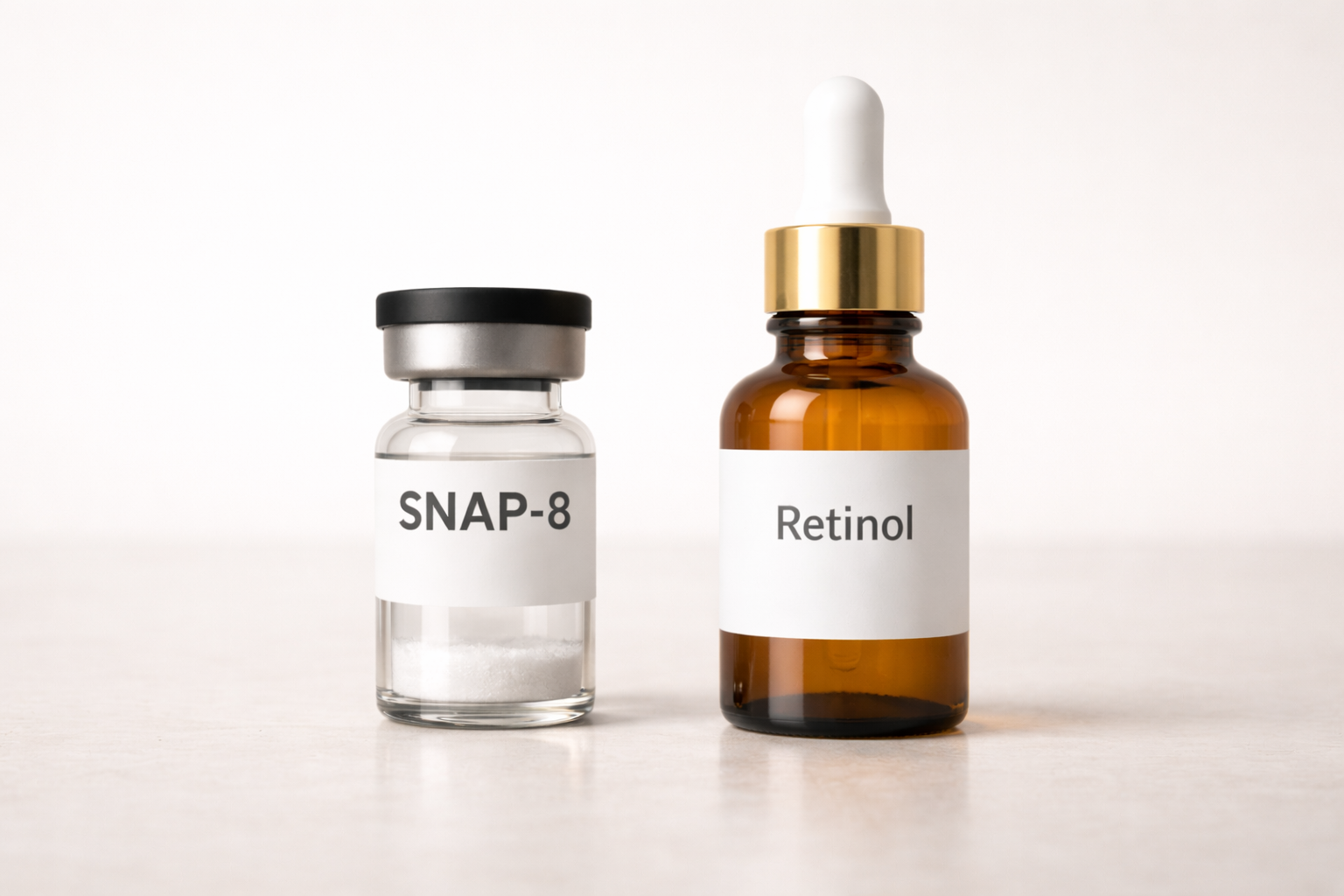
In the quest for ageless skin, two heavyweights often dominate the conversation: Retinol and SNAP-8 peptide (Acetyl Octapeptide-3). Retinol is widely regarded as the gold standard for cellular turnover and collagen production. Meanwhile, SNAP-8 is the cutting-edge “topical neuromodulator” designed to relax expression lines. On paper, they are the perfect duo. One rebuilds the skin’s foundation. The other prevents the mechanical creasing that causes wrinkles.
However, combining these two requires more than just slathering them on at the same time. Retinol is notoriously “fussy,” often causing redness, peeling, and sensitivity if mishandled. SNAP-8, while gentle, needs a stable environment to penetrate effectively. To harness the power of both without compromising your skin barrier, you need a strategic approach to layering.
For a complete system covering timing, stacking partners, cycling, and advanced techniques, follow Advanced SNAP-8 routines.
Understanding the Power Couple
To layer these ingredients safely, we must first understand why they are worth the effort of a complex routine.
The Role of SNAP-8
SNAP-8 is a synthetic peptide that mimics a protein involved in muscle contraction. When you apply it, it intercepts the chemical signals that tell your facial muscles to squint, frown, or smile. By “muffling” these signals, it allows the skin to remain smooth. Research indicates that SNAP-8 can reduce wrinkle depth by up to 30% when used consistently [1, 2].
The Role of Retinol
Retinol is a derivative of Vitamin A. Its primary job is to speed up cell turnover. This is the process where your skin sheds dead cells and replaces them with fresh, new ones. It also travels deep into the dermis to stimulate the production of collagen and elastin. While SNAP-8 works on the “movement” side of wrinkles, Retinol works on the “structural” side [4, 7].
Why Irritation Happens: The Barrier Connection
The biggest hurdle in this routine is the skin barrier. Retinol works by thinning the very top layer of dead skin while thickening the deeper layers. During this transition, the skin barrier can become temporarily compromised. This causes “Retinoid Dermatitis.” It’s characterized by redness, itching, and flaking.
If you apply SNAP-8 or other products onto a barrier that is already “angry” from Retinol, you may experience stinging or increased sensitivity. Furthermore, if the skin is too irritated, the resulting inflammation can actually trigger enzymes that break down the very collagen you are trying to build [2, 5].
Safe Layering Tip #1: The “Sandwich Technique”
If you have sensitive skin or are new to Retinol, the “Sandwich Technique” is the safest way to incorporate SNAP-8 into your evening routine.
- The First Layer: Apply a hydrating serum (like Hyaluronic Acid) or your SNAP-8 serum first.
- The Middle Layer: Apply a pea-sized amount of Retinol.
- The Top Layer: Apply a ceramide-rich moisturizer.
By putting the SNAP-8 down first, you provide a hydrating buffer that slows the absorption rate of the Retinol. This makes it less likely to cause a “shock” to the system. This doesn’t make the Retinol less effective. Rather, it simply makes the delivery more controlled and tolerable for the skin barrier [5, 8].
Safe Layering Tip #2: Separate by Time and Day
For maximum results with zero irritation, many dermatologists recommend a “Circadian” approach.
SNAP-8 in the Morning
For a deeper breakdown of morning vs night performance, see best time to apply SNAP-8.
Use your SNAP-8 in the morning. Since its primary job is to buffer facial expressions, it makes the most sense to have it active while you are awake and moving your face. This also keeps the peptide away from the Retinol. Thus, it eliminates any risk of chemical interference or increased sensitivity.
Retinol at Night
Save the Retinol for your evening routine. Retinol is photolabile. This means it breaks down and becomes useless when exposed to sunlight. By applying it at night, you allow it to work during the skin’s natural repair cycle without environmental interference [3, 5].
Managing the pH Balance
One of the scientific reasons for separation is the pH level. Retinol typically requires a slightly acidic to neutral environment to convert into its active form, retinoic acid, within the skin. SNAP-8 is a delicate chain of amino acids that can be broken apart if the environment is too acidic.
If you are using a prescription-strength retinoid or a very “active” retinol, the acidic shift in the skin can potentially “denature” the SNAP-8 peptide, rendering it inactive. By waiting 20 to 30 minutes between applying SNAP-8 and Retinol, you allow the skin’s pH to stabilize. This ensures both ingredients remain “alive” and functional [6, 7].
The Role of Moisture: The “Glow” Multiplier
When you use Retinol, your skin undergoes increased transepidermal water loss (TEWL). Essentially, moisture evaporates out of your skin faster.
SNAP-8 thrives in a hydrated environment. If your skin is dry and “leaky” due to Retinol use, the SNAP-8 molecules won’t have the “water bridge” they need to travel deep into the skin. To avoid this, always pair this duo with ingredients like Squalane or Ceramides. These fats act as the “mortar” between your skin-cell “bricks.” Thus, it seals the SNAP-8 in and prevents the Retinol from causing excessive dryness [7, 8].
For an exact hydration-first layering flow (including HA timing), use stacking SNAP-8 with hyaluronic acid & vitamin C.
Troubleshooting: What to Do if Irritation Occurs
Even with perfect layering, the “Retinol Purge” can happen. If your skin starts to feel tight, looks shiny, or develops red patches, follow these steps:
- Stop the Retinol for 3 days, but continue using the SNAP-8. Peptides are non-irritating and can help soothe the skin during a flare-up.
- If you can’t tolerate Retinol left on all night, apply it, wait 30 minutes, and then wash it off. Follow up with your SNAP-8 and moisturizer. This allows the skin to get a “taste” of the Retinol without the prolonged exposure that causes peeling.
- Often, it isn’t the Retinol/SNAP-8 combo causing the issue, but a harsh cleanser. Switch to a non-foaming, creamy cleanser to preserve the lipids that your Retinol is already stressing [4, 5].
The Timeline of Transformation
Combining these two is a marathon, not a sprint. Because they work on different biological timelines, you will see results in stages.
- Weeks 1-2: You might feel slight tingling. Focus on hydration.
- Weeks 4-6: The SNAP-8 starts to noticeably soften the “elevens” between your brows and your forehead lines.
- Weeks 12+: The Retinol has finally stimulated enough new collagen that the skin feels firmer and thicker. At this point, the synergy of the two ingredients creates a “glass skin” effect that looks both smooth and structurally sound [1, 6].
Conclusion: A Strategic Alliance
Layering SNAP-8 with Retinol is one of the most effective non-invasive ways to combat the signs of aging. By respecting the “Sandwich Technique,” maintaining a healthy pH balance, and prioritizing hydration, you can bypass the common pitfalls of irritation.
The goal is to move the skin from a state of “stress” to a state of “repair.” When these two ingredients work in harmony, they don’t just hide wrinkles. They also fundamentally change the way your skin moves and ages. Be patient, watch your barrier, and let the science of peptides and retinoids do the heavy lifting for you.
Advanced Synergy: Boosting the Barrier with Niacinamide
If you find that the Retinol and SNAP-8 combination is still causing a bit of redness, there is a “secret” third ingredient that can stabilize the entire stack: Niacinamide (Vitamin B3).
Niacinamide is unique because it increases the production of natural fats in the skin. Research has shown that applying Niacinamide alongside a retinoid significantly reduces the incidence of irritation [7]. In the context of our SNAP-8 routine, Niacinamide acts as the “peacekeeper.” It keeps the skin barrier strong enough to handle the Retinol while creating a smooth, hydrated surface for the SNAP-8 to glide through.
How to Add Niacinamide to the Stack:
- Apply a 5% Niacinamide serum or a moisturizer containing it.
- Follow with SNAP-8.
- Wait 10 minutes, then apply your Retinol.
The “Peptide-First” Philosophy: Why it Matters
If you’re combining retinoids with advanced penetration methods, review the protocol for microneedling with SNAP-8 before adding devices to an active routine.
In traditional skincare, the rule is “thinnest to thickest.” However, when dealing with neurotransmitter-inhibiting peptides like SNAP-8, we often follow a “Peptide-First” philosophy.
Because SNAP-8 needs to reach the nerve-to-muscle junction, it has a long way to travel. If it is layered over a thick Retinol cream or a heavy oil, it may never make it past the surface. By applying your SNAP-8 serum to freshly cleansed, slightly damp skin, you ensure the highest possible concentration of the peptide reaches the target tissue before other ingredients create a barrier [1, 8].
Environmental Factors: The “Inflammaging” Risk
Using Retinol makes your skin more “photosensitive.” This means it reacts more aggressively to the sun. In turn, it causes “inflammaging,” aging caused by chronic, low-grade inflammation.
If you are using SNAP-8 to relax your wrinkles but you are skipping sunscreen while on a Retinol regimen, you are fighting a losing battle. The sun will cause micro-scars in the collagen matrix that even the strongest Retinol can’t fully repair.
If you use Retinol and SNAP-8, a mineral-based SPF (Zinc Oxide or Titanium Dioxide) is non-negotiable every single morning. This protects the “new” skin cells the Retinol is creating and prevents UV rays from breaking down the SNAP-8 peptide chains [3, 4].
Understanding Concentration: Less is Often More
A common mistake in the “Max Absorption” quest is thinking that a higher percentage of Retinol will lead to faster results when combined with SNAP-8. In reality, a lower-percentage Retinol (0.25% to 0.5%) used consistently is far more effective than a high-percentage Retinol (1.0% or higher) that forces you to stop treatment every few days due to peeling.
When the skin is constantly peeling, it is in a “trauma state.” In this state, SNAP-8 cannot function effectively because the skin’s resources are diverted toward basic wound healing rather than muscle relaxation. For the best synergy, choose a moderate-strength Retinol that allows you to maintain a daily (or every-other-day) routine without visible irritation [2, 6].
The “Bio-Hacking” Approach: Skin Cycling with SNAP-8
To further minimize irritation while maximizing the benefits of this power couple, many experts suggest a “Skin Cycling” approach. This method prevents the over-processing of the skin while ensuring SNAP-8 is always present to do its job.
- Night 1: Exfoliation (to clear the path for the following nights)
- Night 2: Retinol + SNAP-8 (the heavy-hitting structural work)
- Night 3 & 4: Recovery nights (SNAP-8 + focused hydration/ceramides)
For a structured week-by-week plan using boosts and maintenance phases, follow cycling SNAP-8.
By giving the skin two nights of rest from the Retinol, the barrier can rebuild itself. However, because you continue to use the SNAP-8 on recovery nights, you keep the muscle-relaxing signals consistent. This ensures that you don’t lose progress on your wrinkle-smoothing goals [5, 6].
Targeted Application: Precision over Volume
Because SNAP-8 is designed for “expression” lines, you don’t necessarily need to apply it to your entire face if you are using it alongside a full-face Retinol application.
The Precision Method:
- Apply your Retinol to the entire face and neck.
- Wait 15 minutes.
Target only the high-movement areas with your SNAP-8: the forehead, the glabella (the “11s” between the brows), and the orbital bone (crow’s feet).
This targeted approach allows you to use a higher concentration of the peptide where it is actually needed. Meanwhile, it allows the Retinol to handle the general texture and tone of the rest of your face [1, 2].
The Biology of Sleep and Skin Repair
The reason we favor the evening for the Retinol/SNAP-8 stack is deeply rooted in our biology. At night, the body enters a state of parasympathetic dominance, where repair hormones like melatonin and growth hormones peak.
During sleep, skin cell division increases. When Retinol is present during this peak division time, it “guides” the new cells to form correctly and stimulates the fibroblasts to pump out more collagen. By adding SNAP-8 to this nighttime environment, you are ensuring that as these new cells form and as collagen is deposited, it is doing so in an environment where the skin is relaxed and not being constantly tugged by muscle contractions [3, 5].
Final Checklist for Safe Layering
To ensure your SNAP-8 and Retinol stack is a success, keep this checklist on your bathroom mirror:
- Am I using a gentle, sulfate-free cleanser?
- Is my skin slightly damp when I apply the SNAP-8?
- Did I give the SNAP-8 at least 5-10 minutes to sink in before applying Retinol?
- Am I using only a pea-sized amount of Retinol for my entire face?
- Did I use a moisturizer to “lock” everything in?
- Did I apply SPF this morning?
By following these simple guidelines, you turn a potentially irritating routine into a professional-level anti-aging system. The combination of SNAP-8 and Retinol is truly the “gold standard” for those who want to see real, biological changes in their skin’s texture and movement.
Citations
[1] Trending Anti-Aging Peptides: Acetyl Octapeptide-3 Prevalence and Mechanisms – MDPI. https://www.mdpi.com/2079-9284/7/4/91
[2] Peptides: Emerging Candidates for the Treatment of Skin Senescence – NIH. https://pmc.ncbi.nlm.nih.gov/articles/PMC11762834/
[3] The molecular clock in the skin, its functionality, and how it is disrupted – NIH. https://pmc.ncbi.nlm.nih.gov/articles/PMC11105295/
[4] Retinoids in the treatment of skin aging: an overview of clinical efficacy and safety – NIH. https://pmc.ncbi.nlm.nih.gov/articles/PMC2699641/
[5] Biological Rhythms in the Skin – NIH. https://pmc.ncbi.nlm.nih.gov/articles/PMC4926335/
[6] An Open Label Clinical Trial of a Peptide Treatment Serum and Supporting Regimen Designed to Improve the Appearance of Aging Facial Skin – NIH. https://pubmed.ncbi.nlm.nih.gov/27602972/
[7] Niacinamide and its impact on stratum corneum hydration and structure – NIH. https://pmc.ncbi.nlm.nih.gov/articles/PMC11811021/
[8] Advantages of Hyaluronic Acid and Its Combination with Other Bioactive Ingredients in Cosmeceuticals – MDPI. https://www.mdpi.com/1420-3049/26/15/4429
