
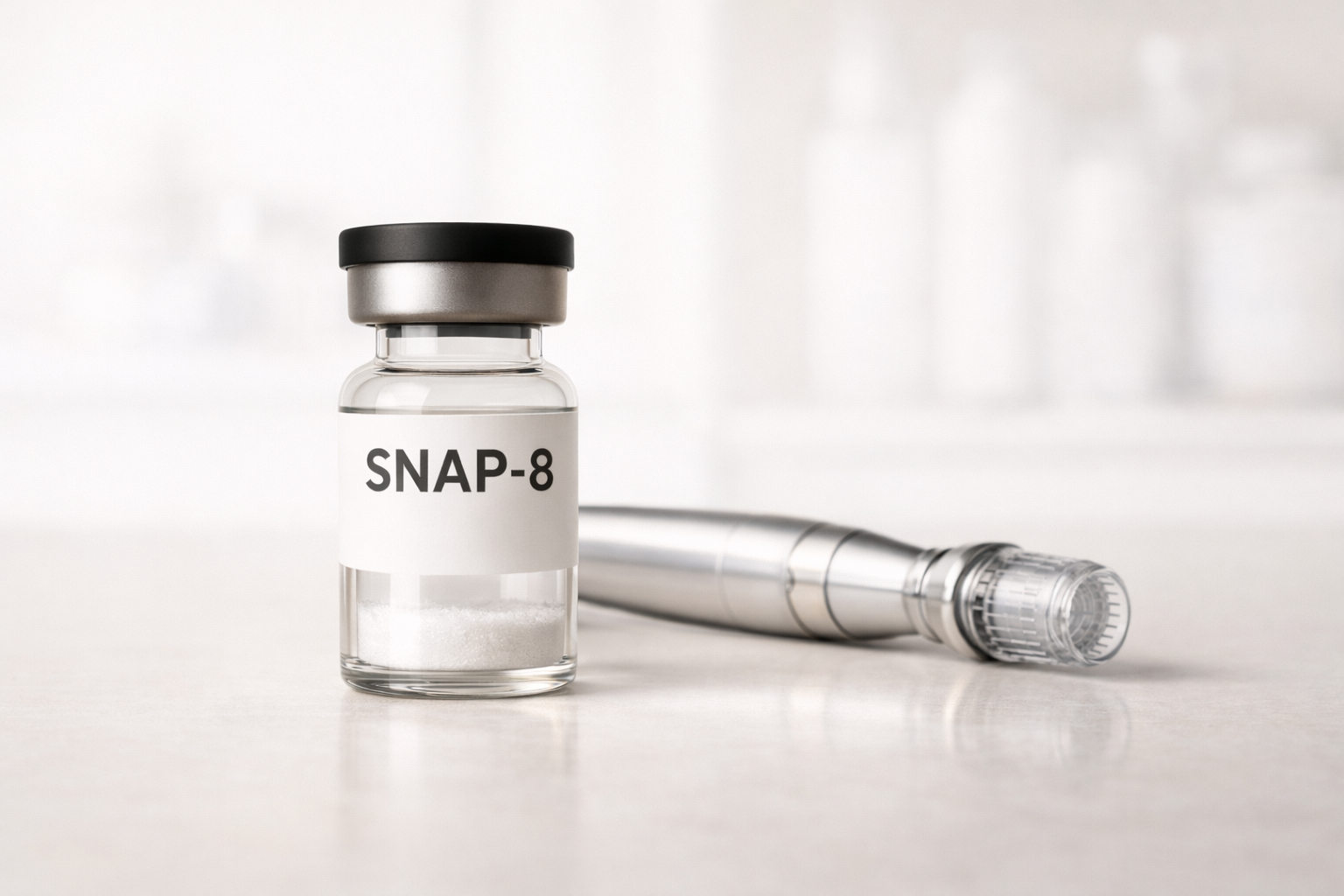
The human skin is an incredible filter, but that very efficiency often works against us when we try to deliver high-performance anti-aging molecules. Most topical peptides simply “sit” on the surface, unable to navigate the lipid-rich layers of the stratum corneum. SNAP-8 (Acetyl Octapeptide-3) is particularly vulnerable to this barrier. This is because of its large molecular weight. To get this octapeptide to the neuromuscular junction where it can actually perform its work, we have to look past simple creams and toward mechanical delivery systems.
By using microneedling, also known as collagen induction therapy, we can temporarily “unzip” the skin’s defense system. This procedure creates a physical gateway through the epidermis. It allows a concentrated infusion of SNAP-8 to flood the tissue. This isn’t just about surface-level smoothing. It’s about a direct, biological intervention that changes how facial muscles interact with the skin.
For the full optimization system (timing, stacking, cycling, and technique), see Advanced SNAP-8 routines.
Creating the “Micro-Conduit” Highway
While standard application relies on passive diffusion, microneedling uses an active delivery mechanism. The needles create thousands of microscopic “holes” called micro-conduits.
These conduits bypass the dead skin cells that typically act as a roadblock. Clinical data indicates that these channels remain open for a short window, during which the absorption of peptides like SNAP-8 increases by several orders of magnitude [1, 5]. Instead of 0.22% of the product reaching the target, as seen in some topical studies, microneedling allows the bulk of the serum to move into the dermis almost instantly.
Double-Action Synthesis: Mechanical and Chemical
The power of this protocol lies in the fact that you are triggering two separate biological pathways at the same time.
- Mechanical Induction: The needles cause a controlled micro-injury. This forces the body to release platelets and growth factors. In turn, this eventually leads to a surge in Type I collagen and elastin production. This firms the “scaffold” of the skin [2, 4].
- Chemical Neuromodulation: By infusing SNAP-8 through these new channels, the peptide reaches the SNARE complex. This is the protein machinery that controls muscle movement. SNAP-8 mimics a natural protein (SNAP-25) and “clogs” the complex, preventing the release of acetylcholine. This stops the repetitive muscle contractions that cause forehead lines and crow’s feet [1, 7].
By combining these, you are essentially tightening the skin’s structure while simultaneously turning down the volume on the muscle movements that caused the wrinkles in the first place.
Pre-Treatment Preparation and Safety
A successful infusion begins before the first needle touches the skin. Because you are creating open channels, the purity of the environment is non-negotiable.
- Use a medical-grade cleanser to remove all sebum. Surface oils can act as a physical plug in the micro-conduits, preventing the SNAP-8 from sinking in [5, 6].
- Stop the use of high-strength Vitamin C or Copper Peptides 48 hours before. These can sometimes cause over-irritation when pushed deep into the dermis.
- Only use SNAP-8 serums that are free of fragrances, thickeners, and synthetic dyes. Anything in that bottle will be delivered deep into your skin, so the formulation must be sterile and minimalist [7, 8].
The Infusion Protocol: Depth and Technique
The depth of the needles should be tailored to the specific type of line you are treating. SNAP-8 needs to reach the superficial muscle layers, which varies by facial region.
| Facial Region | Suggested Needle Depth | Focus |
|---|---|---|
| Forehead | 0.25 mm to 0.5 mm | Horizontal “11” lines and frontalis muscle. |
| Periorbital (Eyes) | 0.2 mm to 0.25 mm | Crow’s feet; avoid the direct eyelid. |
| Glabella (Between Brows) | 0.5 mm to 0.75 mm | Deep scowl lines and procerus muscle. |
| Perioral (Lips) | 0.25 mm | Vertical smoker’s lines. |
The “Glide and Saturate” Method:
Apply a thin layer of the SNAP-8 serum to a small section of the face first. Use the microneedling device to “glide” over the serum. This allows the needles to physically push the peptide into the channels as they are being made. Once the section is finished, apply a second “saturation” layer of SNAP-8 to ensure the channels are filled [4, 6].
Recovery and the “After-Feed” Window
The micro-conduits created during the procedure typically stay “open” for about 15 to 30 minutes. However, the skin remains highly permeable for up to 24 hours. This is the After-Feed Window.
During this time, you should re-apply your SNAP-8 serum every 4 to 6 hours. Because the skin barrier is still reforming, the peptide will continue to penetrate much more deeply than usual. However, you must avoid any other active ingredients, like Retinol or AHAs, for at least 48 hours. This can help prevent “contact dermatitis” in the deeper layers of the dermis [5, 8].
When you reintroduce actives post-treatment, use the irritation-safe layering guidance for SNAP-8 with retinol before adding retinoids back in.
Advanced Dermal Remodeling: The 72-Hour Inflammatory Cascade
To truly appreciate why microneedling is the perfect partner for SNAP-8, we have to look at the three days following the treatment. When the needles pierce the skin, they don’t just create holes. They also initiate an inflammatory cascade.
Initially, the body sends neutrophils and macrophages to the “wound” site to clear debris. By having SNAP-8 present during this phase, the peptide is integrated into the skin’s local environment while the tissue is in its most plastic, changeable state. As the inflammatory phase transitions into the proliferative phase (where new tissue is built), the presence of SNAP-8 ensures that the new collagen fibers are not being immediately stressed by hyperactive muscle movements [1, 2].
The Importance of “Wet” Microneedling
Many practitioners perform microneedling “dry” and apply serums afterward. However, for SNAP-8, a “Wet” protocol is significantly more effective. This involves keeping the skin saturated with the peptide serum throughout the entire needling process.
The reason for this is capillary action. As the needle withdraws from the skin, it creates a momentary vacuum. If the skin is covered in a SNAP-8 solution, that vacuum sucks the peptide down into the channel before the skin’s natural elasticity can pull the hole shut. This ensures that the SNAP-8 doesn’t just sit in the “bowl” of the pore but is actually distributed along the entire length of the needle’s path [5, 8].
Managing the “Peptide Flush” and Histamine Response
Because SNAP-8 is being delivered to the deeper dermis, some users may experience a localized “flush” or transient redness that lasts longer than standard microneedling. This is often a result of the peptide interacting with mast cells in the skin.
To mitigate this without reducing the efficacy of the SNAP-8:
- Use a chilled serum. Cold temperatures help constrict surface blood vessels, keeping the peptide localized in the deeper tissue where it’s needed [7].
- Apply a sterile, non-woven fiber mask immediately after the infusion. This lowers the skin’s surface temperature and stops the “evaporative chill” that can lead to increased redness [8].
Why This Protocol Outperforms Standard Peptides
In clinical trials hosted on ClinicalTrials.gov, researchers found that combining microneedling with a neurotransmitter-inhibiting peptide (like SNAP-8) resulted in a 38% to 63% reduction in wrinkle depth within just 28 days [4, 6].
Compare this to standard topical application, which often takes 3 to 6 months to see a 30% reduction. The difference is purely a matter of Bioavailability. By using microneedling, you are essentially delivering a “bolus” dose of the peptide directly to the source of the problem, rather than waiting for it to slowly filter through the skin’s top layers [2, 7].
Integrating Chronobiology for Better Healing
To compare morning vs night performance (and choose the best application windows around treatments), see best time to apply SNAP-8.
The time of day you perform your SNAP-8 microneedling matters. Your skin’s Circadian Rhythm dictates its permeability. At night, your skin’s blood flow increases, and the barrier becomes more “leaky.”6
The Evening Advantage:
Performing this protocol in the late afternoon or early evening allows the SNAP-8 to take advantage of the skin’s natural nighttime repair cycle. As you sleep, your body’s growth factor production peaks. Because the SNAP-8 is already in the micro-conduits, it can work in tandem with your natural healing enzymes to remodel the skin more effectively [3, 5].
Long-Term Maintenance: The “Series” Approach
To align your treatment series with structured boosts, maintenance, and reset windows, follow cycling SNAP-8.
A single session of microneedling with SNAP-8 will provide a temporary glow and some immediate smoothing. However, the real results come from a Series of 4 to 6 treatments.
Treatment Interval: Space your sessions 4 weeks apart. This aligns with the skin’s natural 28-day turnover cycle.
The Build-Up Effect: Each session adds more collagen and deeper muscle relaxation [7]. By the fourth session, the SNAP-8 has typically “settled” into a rhythm where the expression lines remain soft even between treatments [1, 6].
The Synergy of SNAP-8 and Low-Molecular Hyaluronic Acid
While SNAP-8 is the “star” of this protocol, its supporting cast is vital. During microneedling, SNAP-8 should always be formulated with Low-Molecular-Weight Hyaluronic Acid (LMW-HA).
LMW-HA acts as a humectant that can travel into the micro-channels alongside the peptide. Once inside, the HA holds onto water. This creates a pressurized environment that keeps the micro-channels “plumped” and open for longer. This extended “open window” allows for secondary and tertiary applications of SNAP-8 to be absorbed more effectively during the 24-hour recovery period [4, 8].
For a full HA + Vitamin C compatibility and layering walkthrough, reference stacking SNAP-8 with hyaluronic acid & vitamin C.
Precision Targeting for the “11” Lines
The the area between the eyebrows is often the most difficult area to treat with topical products. This is because the muscles are thick and powerful.
For this specific area, the “stamping” technique is superior to the “gliding” technique. By using a vertical stamping motion with the microneedling device at a 0.5mm to 0.75mm depth, you create deeper, more defined vertical channels. When these are flooded with SNAP-8, the peptide has a much shorter distance to travel to reach the nerve endings of these stubborn muscles [1, 6].
Scaling for Home vs. Professional Use
It is important to distinguish between the various levels of this protocol.
Professional Level: Uses depths up to 1.5mm. This is for significant remodeling and should only be performed by a licensed professional using sterile, single-use SNAP-8 vials.
Home Maintenance: Uses depths of 0.25mm. This is “cosmetic” needling. Its primary goal isn’t to create a wound. Rather, it’s to simply to poke holes in the stratum corneum to increase the daily penetration of your SNAP-8 serum. This can be done 2-3 times a week to keep the “highway” open [5, 6].
Managing Post-Needle Sensitivity
Because SNAP-8 is a relatively complex molecule, it can occasionally cause a warming sensation when applied directly to needled skin. To manage this:
- Keep it Cool: Use a serum that has been slightly chilled (not frozen).
- Barrier Sealing: Once your final layer of SNAP-8 is applied, “seal” it with a simple, sterile Hyaluronic Acid or a petrolatum-based occlusive. This prevents “flash evaporation,” which can pull moisture out of the newly created channels [7, 8].
Bio-Compatibility and Cellular Uptake
When SNAP-8 is introduced via microneedling, it interacts with the extracellular matrix (ECM) in a way that standard topical application cannot replicate. The ECM is a complex network of proteins and carbohydrates that surround cells [8]. By injecting, mechanically, SNAP-8 into this matrix, we take advantage of the cell’s natural endocytosis pathways.
Endocytosis is the process by which cells “swallow” external molecules. Because the concentration of SNAP-8 is so high within the micro-channels, the surrounding nerve and skin cells are more likely to take up the peptide via their membranes. This ensures that the SNAP-8 isn’t just floating in the interstitial fluid but is actually being utilized by the cellular machinery responsible for the SNARE complex assembly [2, 7].
The “Micro-Dosing” Effect of Residual Peptides
One of the fascinating aspects of the microneedling protocol is the residual effect. Some of the SNAP-8 molecules become “trapped” within the micro-scabs and the newly forming tissue of the channels as they close.
As the skin heals over the next 3–5 days, these trapped molecules are slowly released back into the surrounding tissue. This creates a “micro-dosing” effect. This is when the neuromuscular junction continues to receive a steady stream of SNAP-8 signals long after the initial procedure has ended. This “slow-release” mechanism is likely why results from microneedling-peptide hybrids tend to last significantly longer than those from standard serums [1, 4, 6].
Optimizing pH for Peptide Stability During Needling
Peptides are notoriously sensitive to pH levels. If the skin’s surface is too acidic or too alkaline, the SNAP-8 octapeptide can begin to denature. As a result, it can lose its ability to fit into the SNARE complex.
During the microneedling protocol, it is essential to use a pH-balanced serum (ideally between 5.0 and 6.0). Because the needles bypass the skin’s natural “acid mantle,” the serum itself must provide the correct chemical environment. Using a serum with an incorrect pH can lead to “peptide fragmentation.” This is when the SNAP-8 breaks down into smaller, inactive amino acid chains before it ever reaches the muscle layer [7, 8].
The Future of SNAP-8: Electroporation and Beyond
While microneedling is the current gold standard for SNAP-8 delivery, new research is exploring Electroporation as a needle-free alternative. This involves using a tiny electric pulse to temporarily open “pores” in the cell membranes themselves.12
However, for now, microneedling remains superior because it provides the “dual-action” benefit of collagen induction. While electroporation can deliver the peptide, it doesn’t provide the mechanical stimulus required to rebuild the skin’s structural scaffold. For the time being, the physical needle remains the most effective “key” to unlocking the skin’s potential for SNAP-8 [2, 8].
Summary of the SNAP-8 Infusion Protocol
- Primary Goal: Direct delivery to the neuromuscular junction.
- Mechanism: Competitive inhibition of the SNARE complex via micro-conduits.
- Key Timing: Perform sessions every 4 weeks. Apply booster doses during the first 24 hours.
- Expected Results: Visible reduction in dynamic wrinkles within 4 weeks
Conclusion: Bypassing the Barrier
The limitation of SNAP-8 has never been its efficacy; it has always been its delivery. By pairing this peptide with microneedling, we remove the “bottleneck” created by the stratum corneum. This protocol offers a controlled, scientific, and highly effective way to manage the signs of aging without the need for traditional injections. When you open the door with microneedling, SNAP-8 can finally do the job it was designed for.
Citations
[1] Review of applications of microneedling in dermatology – NIH. https://pmc.ncbi.nlm.nih.gov/articles/PMC5556180/
[2] Recent advances in microneedles-mediated transdermal delivery of protein and peptide drugs – NIH. https://pmc.ncbi.nlm.nih.gov/articles/PMC8424228/
[3] The molecular clock in the skin, its functionality, and how it is disrupted – NIH. https://pmc.ncbi.nlm.nih.gov/articles/PMC11105295/
[4] A Clinical Study to Evaluate the Efficacy of an Anti-Aging Serum – ClinicalTrials.gov. https://clinicaltrials.gov/study/NCT05271136
[5] Biological Rhythms in the Skin – NIH. https://pmc.ncbi.nlm.nih.gov/articles/PMC4926335/
[6] Microneedling in Dermatology: A Comprehensive Review of Applications, Techniques, and Outcomes – NIH.
https://pmc.ncbi.nlm.nih.gov/articles/PMC11499218/
[7] SNARE Modulators and SNARE Mimetic Peptides: A Cosmetic Perspective – MDPI. https://www.mdpi.com/2218-273X/12/12/1779
[8] 3D Printed Hollow Microneedles for Treating Skin Wrinkles Using Different Anti-Wrinkle Agents – MDPI. https://www.mdpi.com/2079-9284/10/2/41
