
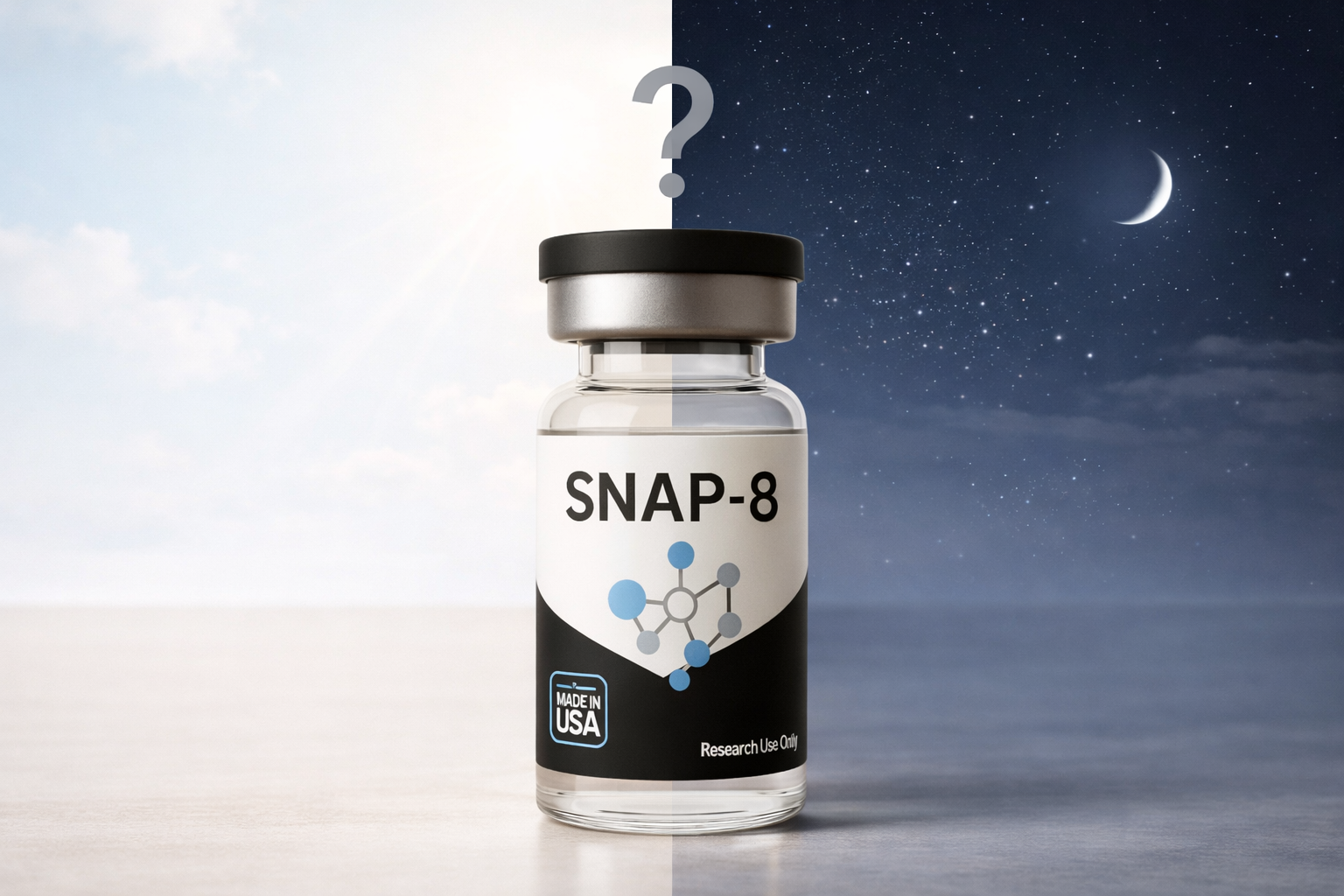
The pursuit of youthful, resilient skin has moved beyond simple moisturizing. In the modern era of dermatology, we are witnessing the rise of “topical neuromodulators.” These are ingredients designed to communicate with the skin’s nerve-to-muscle pathways. At the pinnacle of this category sits SNAP 8 peptide (Acetyl Octapeptide-3). As an advanced evolution of the well-known Argireline, SNAP-8 is an octapeptide designed to reduce the depth of wrinkles caused by facial expressions. However, like any precision tool, its effectiveness depends heavily on when and how it is used.
For a complete framework covering timing, stacking, cycling, and technique, see Advanced SNAP-8 routines.
The question of whether to apply SNAP-8 in the morning or at night is more than a matter of personal preference. It is a question of chronobiology, the study of how our biological rhythms affect skin function. To achieve maximum absorption and visible results, one must align the application of SNAP-8 with the skin’s natural cycles of protection, repair, and permeability.
Understanding SNAP-8: The “Botox-Mimetic” Octapeptide
To determine the best application time, we must first understand what SNAP-8 actually does. Every time you smile, frown, or squint, your brain sends a chemical signal called acetylcholine to your facial muscles. This signal is delivered through a group of proteins known as the SNARE complex.
SNAP-8 is a synthetic peptide that mimics a natural protein in this complex. When applied to the skin, it “competes” for a position in the SNARE complex. By taking the place of the natural protein, it destabilizes the complex and muffles the signal to the muscle. This results in a milder muscle contraction. This prevents the skin from being folded and creased into a wrinkle. Research indicates that this “muffling” effect can reduce wrinkle depth significantly when used consistently over a 30-day period [1, 2].
The Case for Morning Application: The “Expression Buffer”
For many, the morning is the most intuitive time to apply a product designed to limit facial expressions. After all, the morning is when our “active” day begins.
Pre-empting Muscle Tension
Facial expressions are most frequent during daylight hours. From the moment we wake up, our faces are in constant motion. We squint at sunlight, react to work stress, and engage in conversation. By applying SNAP-8 in the morning, you are providing a “buffer” for these movements.
Satiating the nerve receptors with SNAP-8 early in the day ensures that the peptide is present in the tissue before the majority of the day’s muscle contractions occur. This acts as a preventative shield. It potentially reduces the physical stress placed on the skin’s collagen fibers during the day.
Defensive Synergy
For antioxidant compatibility and hydration-first layering, reference stacking SNAP-8 with hyaluronic acid & vitamin C.
In the morning, the skin is in “Protection Mode.” Its primary goal is to defend against environmental aggressors like UV radiation and pollution. Applying SNAP-8 alongside antioxidants like Vitamin C can create a comprehensive defense routine. While the antioxidants neutralize free radicals, the SNAP-8 manages the mechanical stress of facial movement [4, 7].
The Case for Nighttime Application: The “Permeability Window”
While the morning offers protection, the night offers penetration. In the world of skincare science, the night is considered the “Golden Hour” for active ingredients.
Increased Skin Permeability
Our skin follows a circadian rhythm that significantly alters its physical properties over a 24-hour cycle. Studies have shown that skin permeability is generally higher in the evening and at night than it is in the morning [3, 5].
At night, the skin’s barrier becomes more “relaxed.” Transepidermal water loss (TEWL) increases, and the gaps between skin cells become slightly more accessible. Because peptides like SNAP-8 are relatively large molecules, this increased permeability is crucial. Applying SNAP-8 at night allows the peptide to migrate deeper into the skin layers where the nerve-to-muscle junctions are located [5, 8].
Heightened Blood Flow and Temperature
As we sleep, the skin’s temperature rises slightly, and blood flow to the surface increases to facilitate repair. Heat increases the kinetic energy of molecules. This means the active ingredients in your serum can move faster and more efficiently through the skin tissue.
A nighttime application takes advantage of this “internal heat” to drive the SNAP-8 deeper into the dermis. Ultimately, it helps maximize the potential for the peptide to interact with the SNARE complex proteins [3, 4].
Undisturbed Repair
Unlike the morning, where products are often layered under makeup, sweat, and environmental pollutants, nighttime allows SNAP-8 to sit on the skin undisturbed for 7 to 9 hours. This prolonged contact time is essential for large peptides. They require time to slowly filter through the skin’s lipid layers.
The Molecular Depth: How SNAP-8 Navigates the Dermal Matrix
For penetration beyond topical diffusion alone, review the protocols for microneedling with SNAP-8.
To understand why timing is so critical, we must look at the physical journey a peptide takes. The skin is a highly efficient barrier, and SNAP-8 is a relatively “heavy” molecule compared to simple vitamins. Its structure, a chain of eight specific amino acids, is its strength, but also its primary challenge in terms of absorption.
Overcoming the Stratum Corneum
The outermost layer of your skin is a “bricks-and-mortar” structure of dead skin cells and lipids. Water-soluble peptides like SNAP-8 often struggle to pass through this oily barrier. However, during the nighttime “Permeability Window,” the lipid structure is less organized, and the “mortar” is more fluid. This is why applying SNAP-8 before sleep results in higher bioavailability, the amount of the ingredient that actually reaches the target muscle-nerve junction [5, 6].
Targeted Migration
Once the peptide passes the initial barrier, it must move through the dermis toward the nerve endings. This process is called diffusion. Diffusion is highly dependent on skin hydration and temperature. At night, when skin temperature peaks, the kinetic energy of the SNAP-8 molecules increases. This allows them to “wiggle” through the dermal matrix faster than they would during the cooler morning hours [3, 8].
Maximizing Absorption: Beyond the Clock
Regardless of the time of day, there are several ways to ensure your SNAP-8 isn’t just sitting on the surface of your skin.
The pH Factor
Peptides are delicate chains of amino acids. They are most stable and effective when the skin’s pH is between 5.0 and 6.0. If you use highly acidic products, like pure Vitamin C, wait at least 15 to 20 minutes before applying your SNAP-8. High acidity can “unravel” the peptide chain, making it inactive [6, 7].
If your routine includes retinoids, follow the safety guidance for SNAP-8 with retinol to avoid irritation or peptide breakdown.
The Hydration Bridge
Peptides are large. Imagine them trying to walk across a dry desert; they won’t get far. Now imagine them swimming through a river. Applying SNAP-8 to skin that has been pre-hydrated with a Hyaluronic Acid mist or serum creates a “water bridge” that pulls the peptide into the skin more effectively [2, 8].
The “Press and Hold” Technique
Instead of rubbing the serum into your skin, which can cause the product to evaporate or get stuck in the fine lines of your palms, try the “Press and Hold” method. Apply the serum to your fingertips, then press them firmly against your forehead or crow’s feet for 5 to 10 seconds. The warmth of your hands and the steady pressure help drive the molecules into the follicular channels [1, 2].
Advanced Stacking: Synergy with Other Bioactives
In the context of 2026 skincare, we rarely use a single ingredient. The goal is to create a “synergistic stack” that supports SNAP-8 from multiple angles.
SNAP-8 and Niacinamide (Vitamin B3)
Niacinamide is perhaps the best “support” ingredient for peptides. It works by increasing the synthesis of ceramides and fatty acids in the skin barrier.
This pairing creates a stronger, more hydrated barrier. It allows for more controlled and deeper penetration of peptides. Furthermore, Niacinamide helps regulate the skin’s surface pH, keeping it in the “Sweet Spot” where SNAP-8 is most stable [7].
The “Fill and Chill” Method: SNAP-8 + Matrixyl
While SNAP-8 “chills” the muscles to prevent expression lines, signal peptides like Matrixyl (Palmitoyl Pentapeptide-4) help “fill” the skin by stimulating collagen production.
Clinical studies have shown that using a neurotransmitter-inhibiting peptide (like SNAP-8) alongside a collagen-stimulating peptide leads to a much more dramatic reduction in wrinkle depth. You are essentially treating the cause and the effect simultaneously [2, 4].
Troubleshooting Common Absorption Killers
Even with perfect timing, certain habits can “deactivate” your SNAP-8 before it has a chance to work.
The “Oil First” Mistake
Peptides are water-soluble. If you apply a facial oil or a heavy, oil-based cream before your SNAP-8 serum, you have essentially waterproofed your skin. The peptide molecules will sit on top of the oil film and eventually be wiped off on your pillowcase. Always apply your water-based serums first, followed by oils or heavy creams [6, 8].
Over-Exfoliation
While gentle exfoliation helps remove the “Dead Skin Wall,” overdoing it can lead to chronic inflammation. Inflammation triggers the release of enzymes that can break down peptides. To maximize SNAP-8, keep your exfoliation to 1-2 times per week using gentle enzymes or low-percentage acids [4, 5].
Environmental Protection: The Morning Shield
If you choose a morning application, you must account for the modern environment. High-energy visible (HEV) light, also known as blue light, and urban pollution can cause “oxidative stress.” This makes the skin more rigid and less responsive to peptides.
The solution: Layer a broad-spectrum mineral sunscreen over your morning SNAP-8. This prevents UV-induced “stiffening” of the skin. It also allows the peptide to continue its muscle-relaxing work undisturbed by the sun’s inflammatory effects [3, 7].
What to Expect: The Timeline of Results
SNAP-8 is not an instant fix; it is a cumulative treatment. Because it works by gradually modulating muscle signals, you must be consistent.
- Week 1: You may notice improved skin hydration, as SNAP-8 formulations are often paired with moisturizing bases.
- Week 4: The “muffling” effect begins to take hold. You might notice that your forehead feels slightly “relaxed” or that your fine lines appear softer when you smile [2, 6].
- Week 12: Maximum results are typically reached after 3 months of twice-daily use. At this stage, the reduction in wrinkle depth is most visible, and the skin texture appears more refined [1, 8].
Once results stabilize, use structured phases outlined in cycling SNAP-8 to maintain smoothing without plateau.
Conclusion: The Final Verdict
When it comes to the best time to apply SNAP-8, the science suggests that nighttime is superior for pure absorption due to increased skin permeability and higher blood flow. However, morning application is essential for functional protection against the day’s expressions.
For the general public looking for the best possible results, the answer is to integrate SNAP-8 into both ends of your day. By aligning this powerful octapeptide with your body’s natural circadian rhythms, you turn a simple skincare step into a sophisticated biological intervention. Consistency, proper layering, and a respect for the skin’s “internal clock” are the keys to unlocking the full potential of SNAP-8.
Citations
[1] Trending Anti-Aging Peptides: Acetyl Octapeptide-3 Prevalence and Mechanisms – MDPI. https://www.mdpi.com/2079-9284/7/4/91
[2] Sustainable Dynamic Wrinkle Efficacy: Non-Invasive Peptides as the Future of Botox Alternatives – MDPI. https://www.mdpi.com/2079-9284/11/4/118
[3] The molecular clock in the skin, its functionality, and how it is disrupted – NIH. https://pmc.ncbi.nlm.nih.gov/articles/PMC11105295/
[4] Current Approaches in Cosmeceuticals: Peptides, Biotics and Marine Biopolymers – NIH. https://pmc.ncbi.nlm.nih.gov/articles/PMC11946782/
[5] Biological Rhythms in the Skin – NIH. https://pmc.ncbi.nlm.nih.gov/articles/PMC4926335/
[6] Acetyl Hexapeptide-8 in Cosmeceuticals—A Review of Skin Permeability and Efficacy – MDPI. https://www.mdpi.com/1422-0067/26/12/5722
[7] Niacinamide and its impact on stratum corneum hydration and structure – NIH. https://pmc.ncbi.nlm.nih.gov/articles/PMC11811021/
[8] Cosmeceutical Peptides in the Framework of Sustainable Wellness Economy – NIH. https://pmc.ncbi.nlm.nih.gov/articles/PMC7662462/
