
The marketing surrounding SNAP-8, also called Acetyl Octapeptide-3, has created a boom in DIY skincare. This ingredient is often called “Botox in a jar” because it is a small chain of eight amino acids (a peptide) that works by gently relaxing the facial muscles responsible for creating expression lines, such as crow’s feet and forehead wrinkles, without completely freezing movement [4]. For a direct comparison of topical results versus injections, see SNAP-8 vs Botox. SNAP-8 is considered a superior analog to its predecessor, Argireline (Acetyl Hexapeptide-3). It offers enhanced efficacy in reducing the appearance of fine lines by influencing the muscle contraction mechanism [1].
To save money and control exactly what goes on their skin, many people buy SNAP-8 as a pure, dried powder and mix their own serums. This powder is extremely concentrated and sensitive. That said, the right measurements and keeping things clean can make all the difference. This ensures your serum is effective and safe to use. Lack of cleanliness or measurement issues, however, can lead to contamination [3, 8]. One misstep can also affect the ability of the serum to work.
The guide breaks down the process of creating SNAP-8 serum into simple steps. We’ll show you how to safely turn the powder into a liquid you can easily measure and then mix it into two powerful, hydrating anti-wrinkle serums.
Important Note: Before purchasing the peptide, make sure you understand whether you are ordering a standalone SNAP-8 vial or a finished topical formulation. See our guide to reputable places to buy SNAP-8 to compare product formats, testing standards, prices, and available coupon codes.
The Science Behind the Serum

To create an effective and stable cosmetic product, it’s crucial to understand the function of the active ingredients involved. If you want a non-DIY overview of how this ingredient works and why it’s used for expression lines, start with what SNAP-8 peptide is. Understanding the environment they require to remain stable and functional is also critical.
The Neurotransmitter Inhibitory Mechanism of SNAP-8
SNAP-8 belongs to a class of peptides called neurotransmitter inhibitory peptides. Its primary target is the SNARE (Soluble N-ethylmaleimide-sensitive factor Activating Protein Receptor) complex, a group of three proteins (VAMP, Syntaxin, and SNAP-25). This group acts like a lock and key to trigger the release of neurotransmitters at the neuromuscular junction. This release is what signals the muscle to contract and leads to wrinkles [4].
SNAP-8 is a synthetic fragment that mimics the N-terminus of one of these critical proteins, SNAP-25. By competing with the natural protein, SNAP-8 captures the SNARE complex, gently destabilizing its formation [1]. This mild interference reduces the efficiency of acetylcholine release, effectively turning down the signal to contract, rather than breaking the signal entirely like Botulinum Toxin. This results in the relaxation of the facial muscles, softening dynamic wrinkles without the severity of paralysis associated with injections [1, 5].
For a broader breakdown of what these mechanisms translate to cosmetically, see our SNAP-8 peptide benefits guide.
The Importance of Preservative Systems
Since both serum formulas rely heavily on water, they are highly susceptible to contamination by bacteria, yeast, and mold. Using a proper preservative is mandatory. Skipping this step, even if storing the serum in a refrigerator, vastly increases the risk of microbial growth. As a result, this can cause severe skin irritation, infection, or damage around the eye [8].
Furthermore, peptides like SNAP-8 are delicate. They can be broken down by bacteria that thrive in water-based, unpreserved solutions. This can render your expensive active ingredient useless long before its expiration date. The type of container is also critical. It should be stored in an airless pump bottle. Jars, on the other hand, introduce bacteria with every finger dip and constant exposure to air [8].
Necessary Tools, Cleanliness, and Safety
Making a peptide serum is like following a recipe. One small mistake can cause the entire batch to spoil or not function as expected. You must be extremely precise and clean. To avoid the most common formulation and patch-testing errors, review our SNAP-8 beginner mistakes guide before mixing your first batch.
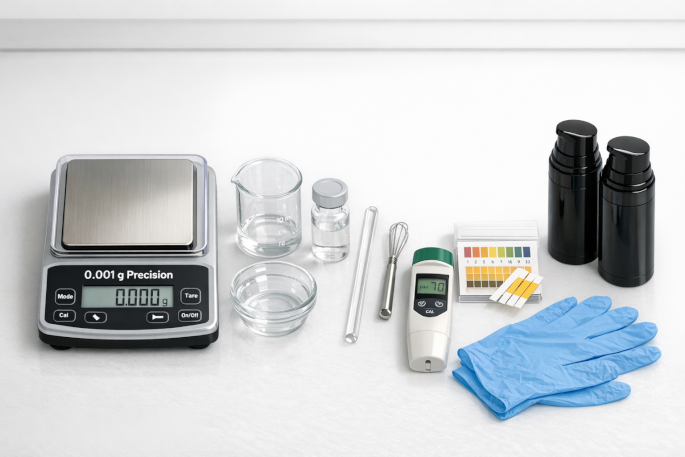
- Super-Accurate Scale (0.001g): This is the most crucial tool. It must measure in tiny amounts (milligrams). If your scale only shows one decimal point (like 0.1g), it is not accurate enough. Thus, it should not be used.
- Sterile Glass Jars/Beakers: Use small, clean glass containers for mixing. Glass is easy to sterilize and won’t react with the ingredients.
- Stirring Tool: A simple glass rod or small stainless steel whisk for mixing. Stir gently to avoid splashing or creating lots of air bubbles.
- pH Test Strips or Meter: You must check the final mixture’s acidity. The mixture should be slightly acidic, typically between pH 5.0 and 6.0 [2]. This is best for the safety of your skin. Slight acidity also aids the activity and stability of many common preservatives.
- Airless Pump Bottles: Peptides break down quickly when exposed to light and air. Use dark, airless pump bottles for your finished serum to keep it fresh [8].
- Disposable Gloves: Never handle pure peptide powder without gloves. Wearing clean gloves can help prevent bacteria from getting into the mix.
Pro Tip: Still deciding between a standalone peptide vial and a ready-made cream? Compare both options in our SNAP-8 buying guide, including third-party testing details and 10% discount codes.
The Golden Rule of Sanitation
- Clean Your Workspace: All surfaces should be wiped down with rubbing alcohol. Let them completely air dry.
- Sterilize Tools: Boil all glass jars, stirring tools, and the final storage bottles in water for 10 minutes. Let them fully air-dry before handling.
- Clean Yourself: Wash your hands thoroughly, put on a face mask, and wear fresh gloves before you start measuring.
Making the SNAP-8 Liquid (Stock Solution)
The powdered peptide is too potent and hard to measure accurately for a single-use serum. First, you must dissolve it in water to create a stable, concentrated Stock Solution that is easy to measure in drops.
Step-by-Step Reconstitution Process
We will make a 5% concentrated Stock Solution. This high concentration is easy to use for calculation and keeps well in the fridge.
Goal: Make 10 grams of a 5% SNAP-8 Stock Solution
| Ingredient | Percentage | Weight (grams) |
|---|---|---|
| SNAP-8 Powder | 5% | 0.50 grams |
| Sterile Water | 95% | 9.50 grams |
| Total Weight | 100% | 10.00 grams |
Weigh the Powder:
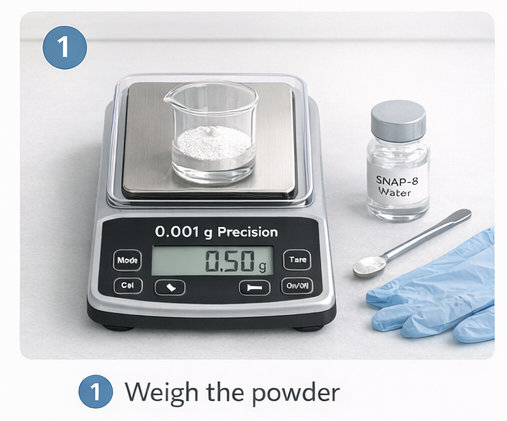
Place a small, sterile glass container on your 0.001g scale and set the weight to zero.
Carefully scoop 0.50 grams of the SNAP-8 powder into the container.
Weigh the Water:
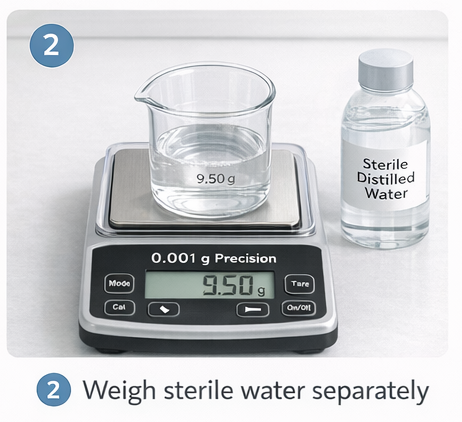
In a separate, sterile container, weigh out 9.50 grams of Sterile Distilled Water. Keep in mind that using water from the tap or a regular filter is not safe for this.
Slowly add the 9.50 grams of water to the container with the peptide powder.
Mix Gently:
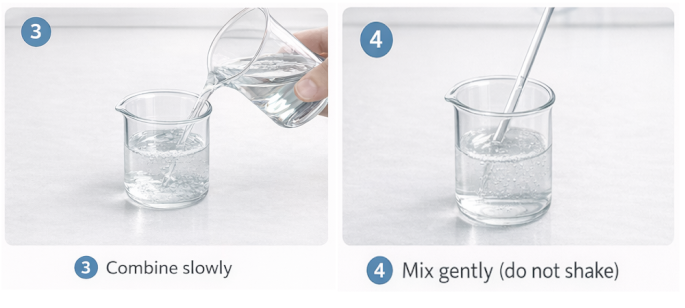
Use the sterile stirring rod. Mix very slowly and gently until the powder is completely dissolved into a clear liquid. It should dissolve quickly. Do not shake.
Label and Store:
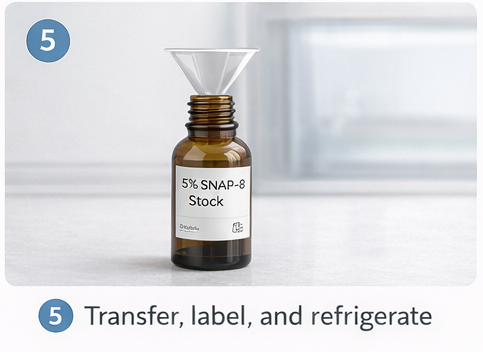
Transfer the liquid into a small, clean dropper bottle. Label immediately with the contents (“5% SNAP-8 Stock”), the date, and the instruction: “KEEP REFRIGERATED.”
This stock solution should be stable in your refrigerator (around 4 degrees Celsius) for about 4 to 8 weeks [6]. For shelf life details beyond the stock solution (including finished serums and creams), see our SNAP-8 storage and stability guide.
Don’t want to measure and mix SNAP-8 yourself? Visit our guide to the best places to buy SNAP-8 to compare a standalone tested vial with a pre-formulated peptide cream.
DIY Anti-Wrinkle Serum Formulas and Ingredient Spotlight
With your 5% SNAP-8 Stock Solution ready, you can now mix it into a complete serum. For these formulas, we will aim for a final product with an effective 5% concentration of the peptide. This is a high-potency, results-focused level [4].
If you’re deciding between strengths for your final formula, review our SNAP-8 concentration guide (3% vs 10%) before adjusting the percentages.
Ingredient Deep Dive
The other components in your serum are chosen not just for hydration but for their known efficacy and ability to work synergistically with SNAP-8.
Hyaluronic Acid (HA) and Molecular Weight: HA is used as a liquid gel base. However, HA’s efficacy is highly dependent on its molecular weight (MW).
- High Molecular Weight (HMW-HA) (over 700 kDa): Forms a smooth film on the skin’s surface. This helps reduce water loss and provides immediate plumping. However, it doesn’t penetrate deeply [3].
- Low Molecular Weight (LMW-HA) (below 100 kDa): Can penetrate deeper into the skin to promote the biological functions of HA in the skin matrix. This includes improving elasticity and promoting tissue repair [3, 7].
- Formulation Note: Using a blend of HA molecular weights is ideal for a comprehensive serum. If your starting material is a pre-made 1% HA liquid, it likely already contains a blend or a high MW version used for texture. If buying powder, select LMW-HA for deeper anti-aging benefits.
Vitamin B5 (D-Panthenol): This provitamin, which converts to pantothenic acid in the skin, is a humectant that also possesses significant soothing and repair properties. It is included in the richer cream formula to offset any potential irritation and enhance the skin’s defense against moisture loss. D-Panthenol has been shown to improve the skin’s barrier function, reduce redness, and accelerate the healing of minor damage. This makes it an excellent partner for active anti-aging ingredients [5, 9].
Formula 1: Simple SNAP-8 and Hyaluronic Acid Serum
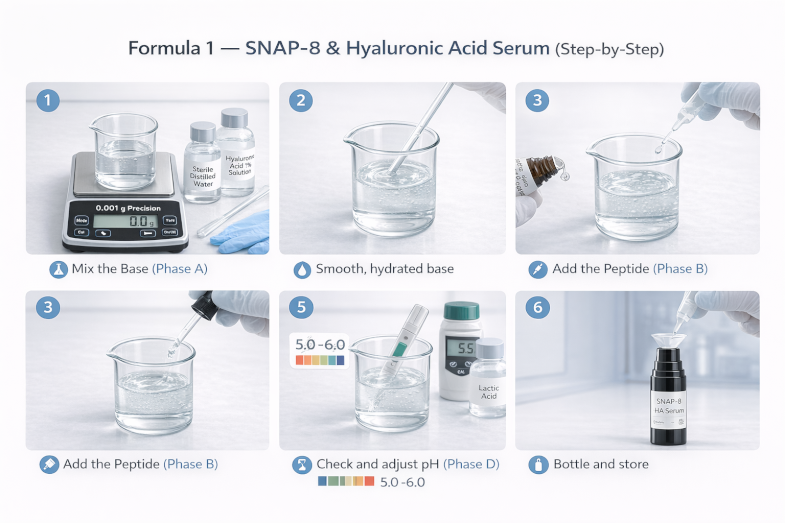
This formula is a light, watery gel that delivers deep hydration from Hyaluronic Acid (HA) while focusing the peptide’s anti-wrinkle effect.
Target Yield: 50 grams (50ml)
| Ingredient | Percentage | Weight (grams) | Role |
|---|---|---|---|
| Sterile Distilled Water (A) | 88.5% | 44.25 grams | Main Liquid Base |
| Hyaluronic Acid (1% Liquid) (A) | 5.0% | 2.50 grams | Hydrating thickener (Surface Plumping) |
| Glycerin (A) | 3.0% | 1.50 grams | Draws moisture to skin (Humectant) |
| SNAP-8 Stock Solution (5%) (B) | 2.5% | 1.25 grams | Anti-Wrinkle Active |
| Preservative (C) | 1.0% | 0.50 grams | Crucial for safety |
| pH Adjuster (D) | Trace | As needed | Sets acidity for skin health |
Mixing Instructions (Simple Serum)
- Mix the Base: In a sanitized glass beaker, weigh the Water, Hyaluronic Acid, and Glycerin. Stir gently until the mixture is completely smooth.
- Add the Peptide (Phase B): Ensure the mixture is cool. Weigh and add the SNAP-8 Stock Solution. Stir gently for three minutes to ensure it is perfectly mixed into the base.
- Add the Preservative (Phase C): Weigh and add the preservative. Stir thoroughly for several minutes.
- Check the pH (Phase D): Use your pH strips or meter to check the liquid’s acidity. If it is outside the 5.0 to 6.0 range, add a single tiny drop of the pH adjuster (Lactic Acid to lower; Sodium Bicarbonate solution to raise) [2]. Mix after each drop until you hit the sweet spot.
- Bottle and Store: Transfer the final serum to your airless pump bottle. Label the date, and store it in a cool, dark place.
Formula 2: Richer SNAP-8 Cream Base
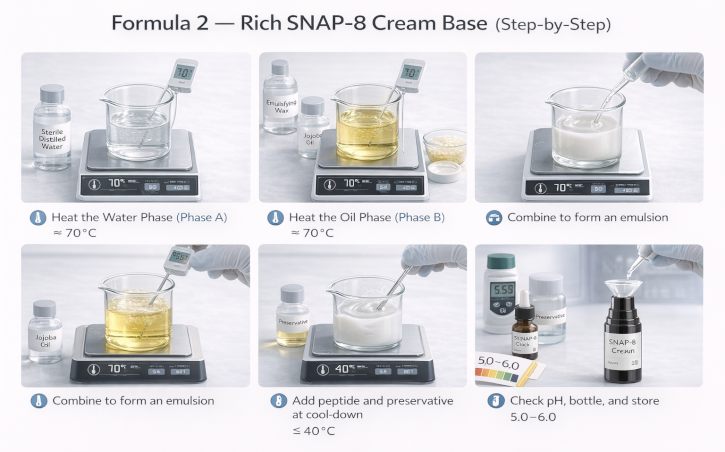
This formula creates a thicker, cream-like lotion. This type of base provides more moisture and helps the peptide penetrate deeper into the skin over time.
Target Yield: 50 grams (50ml)
| Ingredient | Percentage | Weight (grams) | Role |
|---|---|---|---|
| Sterile Distilled Water (A) | 78.0% | 39.00 grams | Water Base |
| Vitamin B5 (D-Panthenol) (A) | 2.0% | 1.00 grams | Soothing and hydrating (Barrier Support) |
| Emulsifying Wax (B) | 5.0% | 2.50 grams | Makes oil and water mix (Emulsifier) |
| Jojoba Oil (B) | 10.0% | 5.00 grams | Moisturizing oil (Emollient) |
| Preservative (C) | 2.0% | 1.00 grams | Crucial for safety |
| SNAP-8 Stock Solution (5%) (D) | 3.0% | 1.50 grams | Anti-Wrinkle Active |
Mixing Instructions (Cream Base)
- Heat the Water (Phase A): In a heat-resistant beaker, weigh the Water and Vitamin B5. Gently heat this mix to about 70°C (158°F).
- Heat the Oil (Phase B): In a separate beaker, weigh the Wax and Jojoba Oil. Heat this until the wax is fully melted (also about 70°C).
- Mix to Form Cream: Slowly pour the Water Phase (A) into the Oil Phase (B) while constantly stirring. Keep stirring until the mix thickens into a uniform, creamy white lotion.
- Cool Down: Remove from heat and stir often as the cream cools. This step is critical to ensure proper emulsion formation.
- Add Peptides and Preservative (Phase C & D): Once the cream is lukewarm (below 40°C), weigh and stir in the preservative and the SNAP-8 stock solution. Mixing at a cool temperature is essential to prevent heat degradation of the peptide [5]. Mix thoroughly for several minutes.
- Check the pH: Check and adjust the pH to the desired 5.0 to 6.0 range [2].
- Bottle and Store: Transfer to an airless container, label, and keep in a cool, dark place.
Prefer a ready-made SNAP-8 formula? Read our complete SNAP-8 peptide cream review for a closer look at its peptides, ingredients, and potential benefits.
View the SNAP-8 Cream at Limitless Biotech → Use coupon code Take10 to save 10%.
Essential Use and Safety Tips
- Patch Test First: Always apply a small amount of the finished serum to a patch of skin, like behind your ear or on your inner forearm. Wait 24 hours to check for redness, itching, or irritation before using it on your face. If you experience irritation or want to understand uncommon reactions, read our guide to SNAP-8 side effects and how to avoid them.
- Application: Apply the serum twice daily (morning and night) to clean skin. Focusing on areas with expression lines (forehead, eyes) [4]. For a full routine breakdown (layering, frequency, and target zones), see our How To Use SNAP-8 Peptide guide.
- Timeline: Consistent use is key. You should expect to see noticeable smoothing effects after 4 to 8 weeks [4].
- Preservation is Non-Negotiable: If you skip the preservative, your serum can quickly grow harmful microbes. Thus, it must be thrown out after about a week, even if kept in the fridge.
Citations
[1] Viper Venom and Synthetic Peptides: Emerging Active Ingredients in Anti-Ageing Cosmeceuticals – MDPI. https://www.mdpi.com/2076-3417/15/8/4501
[2] Towards Optimal pH of the Skin and Topical Formulations: From the Current State of the Art to Tailored Products – MDPI. https://www.mdpi.com/2079-9284/8/3/69
[3] Hyaluronic Acid in Topical Applications: The Various Forms and Biological Effects of a Hero Molecule in the Cosmetics Industry – MDPI. https://www.mdpi.com/2218-273X/15/12/1656
[4] Argireline in Treatment of Periorbital Wrinkles – Clinical Trials. https://clinicaltrials.gov/study/NCT01381484
[5] Trending Anti-Aging Peptides – MDPI. https://www.mdpi.com/2079-9284/7/4/91
[6] Investigating the effects of Argireline in a skin serum containing hyaluronic acids on skin surface wrinkles using the Visia® Complexion Analysis camera system for objective skin analysis – NIH. https://pmc.ncbi.nlm.nih.gov/articles/PMC10665711/
[7] Hydrogel-Based Skin Regeneration – NIH. https://pubmed.ncbi.nlm.nih.gov/38396661/
[8] Cosmetics Preservation: A Review on Present Strategies – NIH. https://pmc.ncbi.nlm.nih.gov/articles/PMC6099538/
