
The anti-wrinkle peptide SNAP-8 is often found on labels as Acetyl Octapeptide-3. It is one of the most powerful ingredients you can use to soften expression lines, hence its nickname “Botox in a jar.” For a direct comparison of topical performance versus injections, read SNAP-8 vs Botox. This potent active works by gently and temporarily interfering with the muscle signals that cause dynamic wrinkles like crow’s feet [4]. Whether you’re making your own DIY serum or just buying a high-end cream, you want to make sure this expensive, hard-working ingredient stays effective.
If you’re new to the ingredient itself, start with our foundational explainer on what SNAP-8 peptide is.
SNAP-8 is delicate. It’s a tiny chain of eight amino acids. Like any natural protein, it can break down when exposed to heat, light, and bacteria. If you don’t store it correctly, your serum could become useless long before you’ve used it all up [1].
This guide cuts through the technical jargon to give you the essential, practical rules for keeping your SNAP-8 products potent. It’ll help you keep the product safe from the moment you receive the raw powder to the last drop in your bottle.
Why Your Peptide Breaks Down
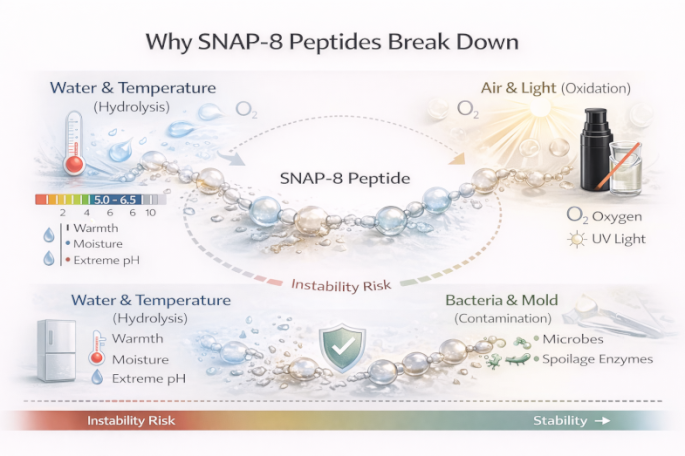
SNAP-8 works by gently blocking a natural communication pathway in the skin that tells facial muscles to tighten up [4]. To maintain this ability, the peptide chain must stay intact. Three main factors cause this chain to break.
If you want a broader overview of what this ingredient is used for cosmetically, see our SNAP-8 peptide benefits guide.
1. Water and Temperature
The biggest enemy of any peptide is water, especially warm water. In chemistry, this breakdown process is called hydrolysis. For us, it’s easier to think of it as the peptide melting away.
How it Works: In a water-based product, water molecules constantly try to break the amino acid links. The warmer the solution, the faster those links break. This is the central challenge in formulating stable products: the peptide must be dissolved in water to work. So, we must manage the environment to slow this inevitable reaction.
The pH Rule: SNAP-8 is most stable in a slightly acidic environment. It should be between pH 5.0 and 6.5 [2]. This pH range is not only ideal for the peptide’s chemical integrity but is also ideal for healthy skin. Skin naturally operates at an average pH of about 5.5. If the formula is too acidic or too alkaline, the breakdown process speeds up dramatically.
The Fridge Solution: Heat accelerates this melting process. So, storing your peptide solution in the refrigerator is an effective way to slow down degradation. A solution stored at room temperature might degrade twice as fast as one kept cool [3]. This simple temperature drop is the most powerful tool a formulator or consumer has to preserve the peptide’s shelf life.
2. Air and Light
When certain molecules react with oxygen, they degrade. Think of metal tarnishing, which peptides can also do.
Oxidation: Peptides can break down when exposed to oxygen. This process is called oxidation. Oxidation is speed up with light exposure, which is why your product needs to be protected [5]. Light energy provides the extra boost needed to kickstart the reaction between the peptide molecules and dissolved oxygen in the solution.
The Packaging Solution: You should only use dark, non-see-through containers for your final serum. A clear bottle sitting on a sunny bathroom shelf is a guaranteed recipe for losing potency fast [5]. This protection applies not only to the finished serum but also to the raw SNAP-8 stock solution.
3. Bacteria and Mold
Any product that contains water is a fertile breeding ground for microorganisms. These microorganisms are often introduced from the air, your hands, or non-sterile mixing tools.
Contamination Danger: Bacteria and mold don’t just make your product unsafe for your skin. They also actively eat the peptide. They produce enzymes that chemically digest the SNAP-8, turning your expensive active ingredient into useless amino acids [9]. A contaminated product can cause severe irritation, redness, or even infection. This makes safety the primary concern over efficacy.
The Safety Mandate: This is why a proper, broad-spectrum preservative is mandatory for any water-containing product. Even if you refrigerate it, skipping the preservative makes the product unsafe for long-term use and negates all efforts toward stability [9]. A good preservative system works synergistically with the correct pH to create an inhospitable environment for microbes.
Handling and Storing SNAP-8 in its Raw Forms
The stability journey begins the moment the raw peptide powder arrives. If you’re preparing the powder at home, follow our step-by-step SNAP-8 reconstitution and mixing guide before making your first stock solution. Every step, from initial storage to reconstitution, must be performed with meticulous care. The proper care can help maximize the peptide’s life.
1. Sourcing and Handling the Pure Powder
High-quality peptides are often sold as laboratory-grade materials. This means the powder is highly purified and requires a specific level of care to maintain its integrity.
Verifying Quality: When sourcing, look for suppliers who can provide a Certificate of Analysis (CoA) that verifies the purity of the Acetyl Octapeptide-3. Low-purity peptide powders contain contaminants that can actually accelerate degradation once mixed into a serum.
Initial Storage (Maximum Life): The unopened vial of pure SNAP-8 powder should be stored long-term in the freezer (below 0 degrees Celsius) [6]. The powder is sealed in a water-free environment, often with a desiccant to absorb any residual moisture. This is its most stable state. The freezer ensures it stays this way indefinitely until use.
Opening Protocol: Only open the container when you are ready to use it. Exposure to atmospheric humidity, especially in a steamy environment like a kitchen or bathroom, will immediately begin the hydrolysis process on the exposed powder. Work quickly and reseal the original container with any unused portion. Return it to cold storage immediately. For the most common handling and formulation slip-ups that reduce potency, review our SNAP-8 beginner mistakes guide.
2. Creating and Storing the Liquid Stock Solution
The powdered peptide is too potent and too light to measure accurately for a single-use cosmetic product. Therefore, formulators must first create a concentrated liquid “stock solution” (e.g., 5% or 10% SNAP-8 mixed in water) to make it measurable in drops or grams. If you’re deciding whether to formulate at 3%, 5%, or 10%, see our SNAP-8 concentration guide (3% vs 10%) for practical selection tips.
The Medium: Only use sterile distilled or deionized water. Tap water or even filtered water contains trace minerals that act as catalysts. These can dramatically speed up the oxidation and breakdown of the peptide [6].
Reconstitution Process: The key to stability at this stage is to ensure the sterility of the mixing environment and tools. Use a super-accurate scale (0.001g) to weigh the powder, and mix it with sterile water using a sterilized glass rod. Transfer it immediately into a small, dark dropper bottle.
Stock Solution Storage Time: An unpreserved SNAP-8 stock solution must be refrigerated immediately in a tightly sealed, opaque container. Even perfectly stored, this highly concentrated solution is only considered stable for approximately 4 to 8 weeks [6]. The constant low temperature is the only thing preventing rapid breakdown.
Advanced Formulation and Stability Strategies
The stability of the final product, like a serum or cream, relies on the careful selection of base ingredients and the management of heat and pH during the mixing process.
1. Water-Based Serums
These are simple mixtures, typically SNAP-8 dispersed in a thick gel of Hyaluronic Acid (HA) and Glycerin.
Hyaluronic Acid (HA) and Molecular Weight: HA is generally very stable and compatible with SNAP-8 [3]. However, the molecular size matters:
- High Molecular Weight HA (HMW-HA): Creates the classic thick gel texture and sits on the skin’s surface. In turn, it offers powerful surface hydration and plumping. It does not penetrate deep enough to enhance the peptide’s delivery [8].
- Low Molecular Weight HA (LMW-HA): This smaller molecule can absorb deeper into the skin [8]. As a result, it can support the skin’s natural matrix and potentially improve the peptide’s access to its target area [7]. A blend of both HMW and LMW HA is considered the most comprehensive base.
Glycerin and Humectants: Glycerin and other ingredients that draw moisture are included for hydration but also serve a secondary stability role. They help bind some of the “free water” in the formula, potentially reducing its availability for hydrolysis.
2. Emulsion-Based Creams
Creams are more complex. They involve an oil phase (butters, oils) and an aqueous phase (water, actives). These are held together by emulsifiers.
The Thermal Threat: Emulsions require heating both the water and oil phases to about 70-80 degrees Celsius. This ensures the emulsifying wax properly melts and integrates the phases. This heat is the biggest stability threat to SNAP-8.
Cool Phase Addition: SNAP-8 is a cool-down phase ingredient. After the oil and water phases are mixed to form the cream, the mixture must be allowed to cool down to below 40 degrees Celsius before the SNAP-8 stock solution is added [5]. Adding the peptide at high heat will immediately destroy it.
Compatible Emollients: Using stable emollients like jojoba oil or shea butter is preferred over highly unsaturated oils. The latter are prone to oxidation and can create breakdown byproducts that destabilize the peptide.
3. Synergistic Ingredients (The Power of B5)
Ingredients that support skin barrier function are ideal partners for SNAP-8. A strong barrier enhances the skin’s ability to retain the active ingredient.
Provitamin B5 (D-Panthenol): This provitamin is extremely stable and offers significant benefits. It can help soothe and hydrate the skin, improve its barrier function, and accelerate minor healing. It is highly compatible with the pH required for SNAP-8. In turn, this makes it a powerful, gentle addition to any peptide formula [5, 9].
4. Avoiding Destabilizing Ingredients
Formulators must be cautious when mixing SNAP-8 with other powerful actives:
AHA/BHA (Glycolic Acid, Salicylic Acid): These exfoliating acids often require a very low pH (typically 3.0 to 4.0) to function properly. This highly acidic environment is outside the SNAP-8 stability window (5.0-6.5) and will accelerate its hydrolysis. Combining them is possible only through advanced compartmentalized packaging or if used at a higher pH where the acids are less effective.
Unstabilized Vitamin C (L-Ascorbic Acid): This antioxidant is extremely unstable in water and rapidly degrades. It releases free radicals that can directly oxidize the SNAP-8 peptide. If Vitamin C is desired, use a stabilized derivative that operates at a higher pH (closer to 6.0) that is more compatible with the peptide.
Maximizing User Shelf Life and Usage
A product’s shelf life doesn’t end when it’s bottled. For application best practices (including how often to apply and where), follow our How To Use SNAP-8 Peptide guide. It ends when it’s empty or when it loses efficacy after opening.
1. Packaging: The Final Line of Defense
The packaging choice is the single most important factor for consumer stability and safety.
The Essential Need for Airless Systems: Traditional packaging methods like jars and dropper bottles fail. They constantly reintroduce oxygen and microbes every time they are opened. This leads to oxidation and rapid microbial growth [9].
Airless Pump Technology: The industry gold standard is the airless pump bottle. This technology uses a vacuum and an internal plate to push the product out without allowing external air back in. This protects the product from oxidation. It also prevents microbial contamination and ensures the user can utilize nearly 100% of the product without wastage. Always transfer your finished serum or cream into a fully opaque airless pump bottle [5].
2. Best Practices for Consumer Storage
Consumers must treat their peptide products with care to preserve the integrity of the formula:
The Cool, Dark Place: Store the product in a location where the temperature is stable and cool. This might include a closet, cabinet, or drawer. Avoid the top of a dresser where it might be exposed to sunlight. Also, avoid the bathroom counter where it might be exposed to steam and heat from a shower.
Refrigeration: While a well-preserved, commercially produced SNAP-8 serum is shelf-stable at room temperature, storing it in the refrigerator (4 degrees Celsius) can offer an added layer of chemical stability. It can significantly slow the rate of hydrolysis and extend the functional life beyond the labelled expiration date. This is especially recommended if the user lives in a hot climate.
Monitoring Period After Opening (PAO): The PAO symbol (an open jar icon with a number) indicates how many months the product is guaranteed to be safe and effective after the first use. Given the sensitivity of peptides, users should adhere to a strict 6-month PAO. Always write the opening date directly on the bottom of the bottle to avoid guessing.
3. Troubleshooting: Recognizing Spoilage and Degradation
A user should discard a SNAP-8 product immediately if any of the following are observed:
If you’re trying to distinguish irritation from spoilage-related reactions, see our guide to SNAP-8 side effects and how to avoid them.
Odor Change: A rancid, sour, or overly ‘off’ smell is the most common indicator of microbial contamination (bacteria/yeast). This can sometimes present before any visible change.
Texture Change: If a cream separates into distinct watery and oily layers, the emulsifier system has failed. If a thick serum suddenly becomes thin and runny, the thickening agent has been digested by microbes or broken down by a pH shift.
Color Change: While some ingredients can slightly change color upon exposure, a noticeable shift to brown, yellow, or greenish hues can indicate significant oxidation. This indicates that the peptide has likely lost a substantial portion of its effectiveness.
By carefully controlling pH, temperature, and microbial exposure at every stage, from storing the initial powder to packaging the final serum, formulators can ensure the SNAP-8 peptide remains biologically active and safe for its intended shelf life.
Citations
[1] Argireline in Treatment of Periorbital Wrinkles – Clinical Trials. https://clinicaltrials.gov/study/NCT01381484
[2] Towards Optimal pH of the Skin and Topical Formulations: From the Current State of the Art to Tailored Products – MDPI. https://www.mdpi.com/2079-9284/8/3/69
[3] Hyaluronic Acid in Topical Applications: The Various Forms and Biological Effects of a Hero Molecule in the Cosmetics Industry – MDPI. https://www.mdpi.com/2218-273X/15/12/1656
[4] The anti-wrinkle efficacy of argireline, a synthetic hexapeptide, in Chinese subjects: a randomized, placebo-controlled study – NIH. https://pubmed.ncbi.nlm.nih.gov/23417317/
[5] Peptides: Emerging Candidates for the Prevention and Treatment of Skin Senescence: A Review – MDPI. https://www.mdpi.com/2218-273X/15/1/88
[6] Preparation and stability of cosmetic formulations with an anti-aging peptide – NIH. https://pubmed.ncbi.nlm.nih.gov/17520155/
[7] Cosmeceuticals for Anti-Aging: Mechanisms, Clinical Evidence, and Regulatory Insights—A Comprehensive Review – MDPI. https://www.mdpi.com/2079-9284/12/5/209
[8] Public Interest in Acetyl Hexapeptide-8: Longitudinal Analysis – NIH. https://pmc.ncbi.nlm.nih.gov/articles/PMC10915729/
[9] Cosmetics Preservation: A Review on Present Strategies – NIH. https://pmc.ncbi.nlm.nih.gov/articles/PMC6099538/
